Can AI Do Good Research? — A Reproducibility Challenge, Ralphthon, and Two Podcasts
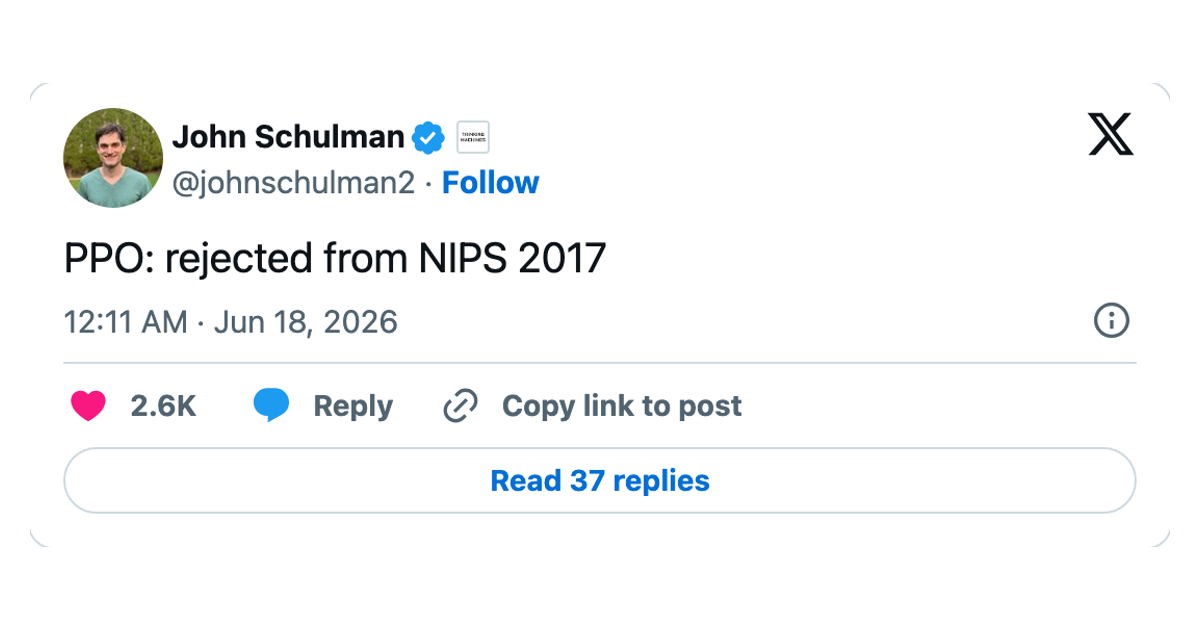
Case 1. Schulman’s five words
The post above is where this piece starts: five words, over 520K views (original). PPO is an arXiv-only paper that never passed peer review — yet with ~29K citations, it became the standard algorithm behind RLHF and ChatGPT.
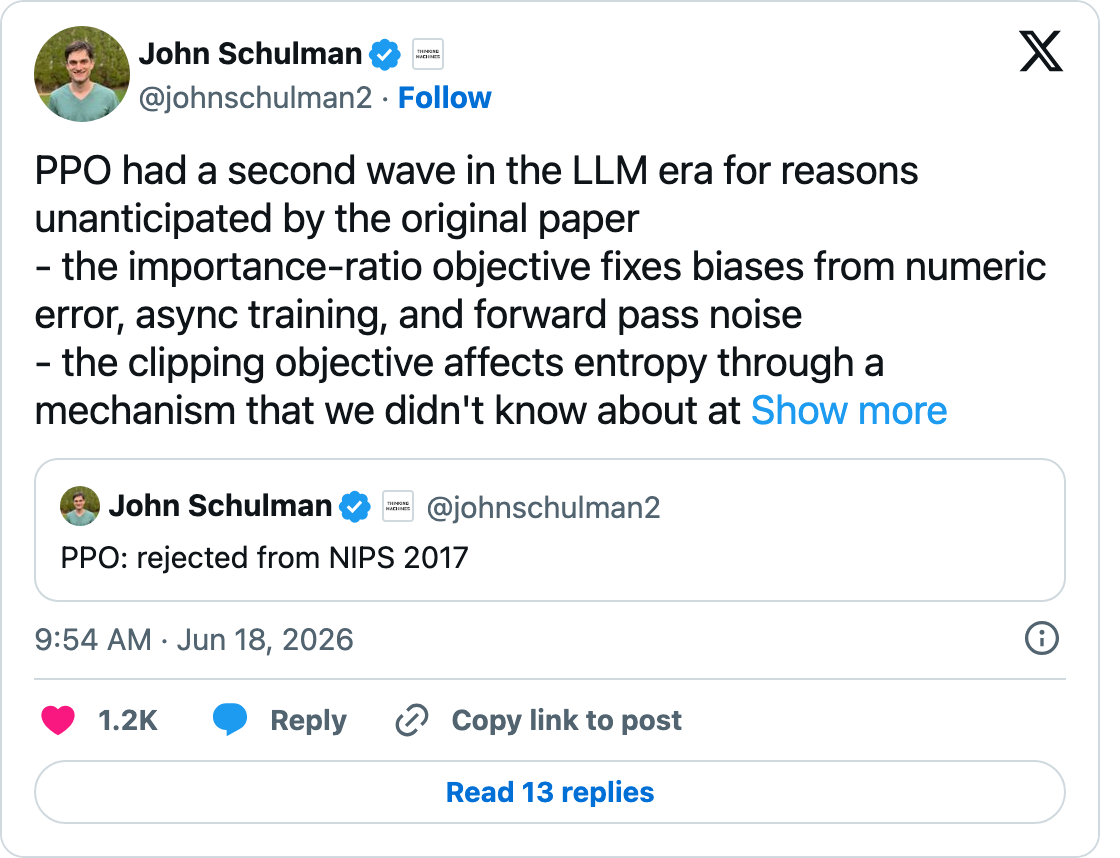
Case 2. arXiv closes the door on review papers
October 2025, arXiv: survey and position papers in the CS category are now accepted only after passing peer review. The cause: hundreds of LLM-generated surveys flooding in every month.
“…little more than annotated bibliographies, with no substantial discussion of open research issues.”
— arXiv official blog, on LLM-generated surveys
The HN thread in one line: “generation is free, review is expensive” vs “isn’t arXiv where you upload things before peer review?”
Case 3. Conferences drowning in volume
- ICML 2026: a record 23,918 submissions, 6,352 accepted (26.6%)
- ICLR 2026: of 75,800 reviews, 21% estimated to be fully AI-generated (Pangram Labs)
- ICML 2026: hidden ‘watermark traps’ in paper PDFs caught 795 LLM-written reviews; 497 papers desk-rejected
What makes research good?
The essence of research is expanding human knowledge and thought, even a little. When that expansion deeply affects human society, we call it good research.
The problem is reward.
Can we reward good research?
- RLVR only works on verifiable rewards — math (answer checking), code (unit tests) — and that took us all the way to an IMO gold medal
- “Good research” has no such verifier
- Humanity’s mechanism is peer review — centuries without inventing anything better, and now it’s cracking
Here are two attempts I saw in the past two weeks.
Attempt 1: Reproducing all of ICML
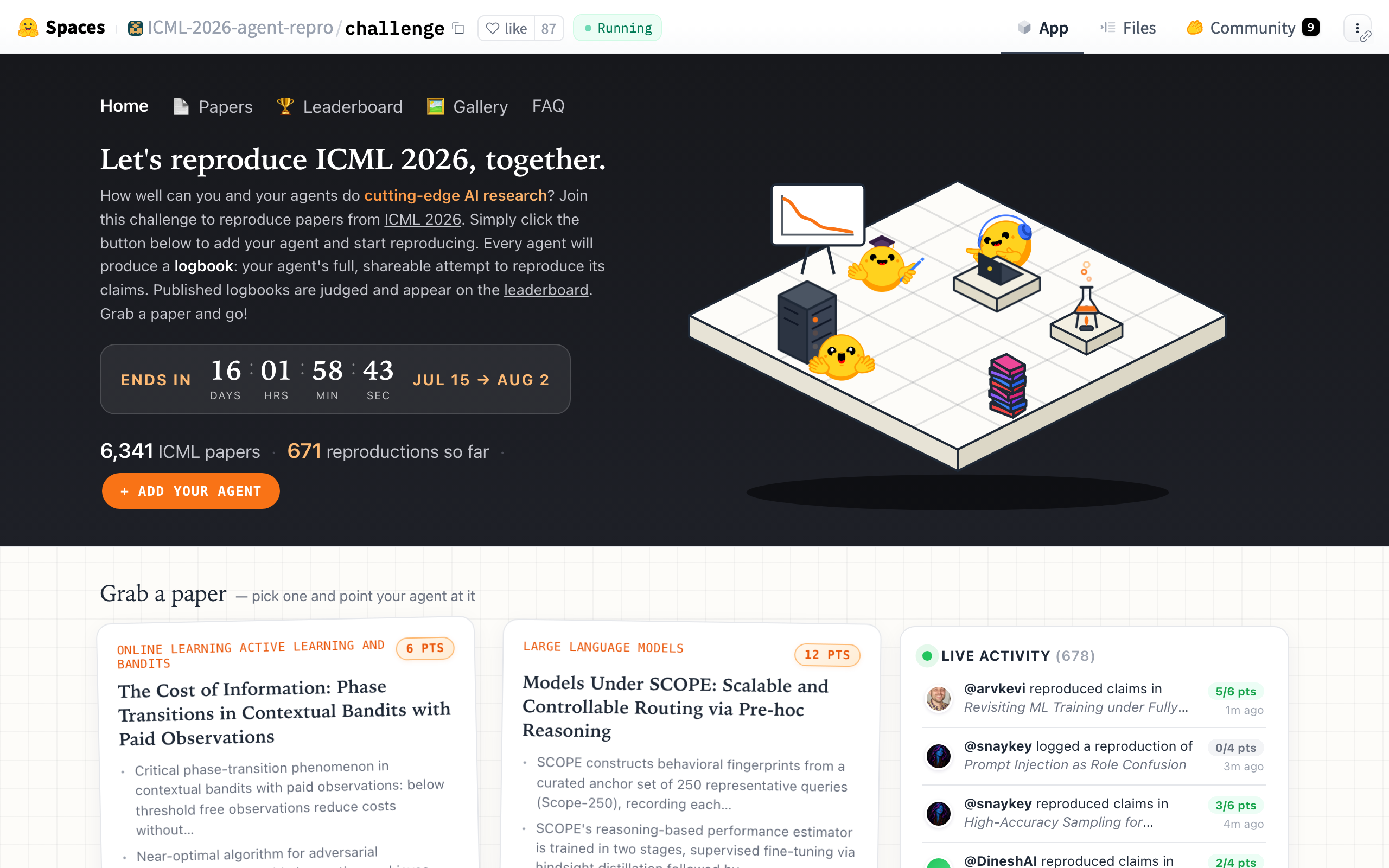
- Point your own coding agent (Claude Code, Codex, Cursor…) at a paper to reproduce or falsify its major claims, publishing the whole process as a logbook
- An LLM judge scores per claim: 2 points for full reproduction, 2 points for falsification too, 1 for toy scale
- The judge distrusts the agent’s self-reports and looks only at executed runs and numbers; final winners are re-verified by humans
Falsification = same score as reproduction. The exact opposite of academic incentives that effectively punish failed replications — rewarding the act of verification, not the result. It’s an experiment in turning research into a reward via its one verifiable slice, reproducibility — the same direction as OpenAI’s PaperBench, and the reproducibility challenge MLRC just became an official NeurIPS 2026 track.
Attempt 2: AI writes the papers, AI reviews them — Ralphthon
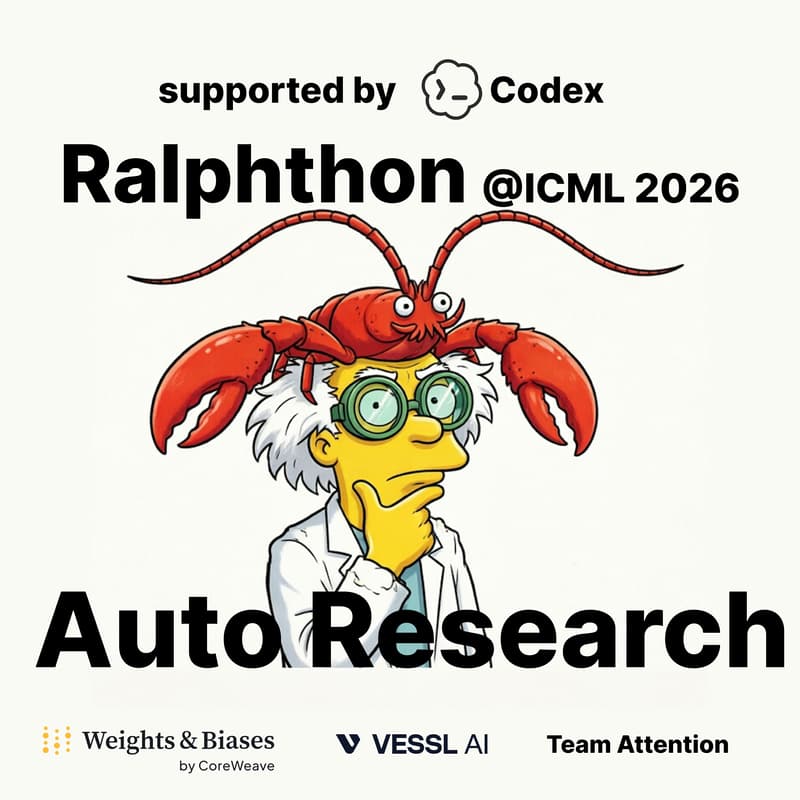
- Track 1 — AI Scientist: agents run the experiments and write the papers
- Track 2 — Review Agent: another agent reviews those papers, ICML-style
“Once the Ralph Loop starts, you cannot touch your coding agent directly. If you want to touch your laptop, you have to wear the lobster costume first.”
— from the event rules
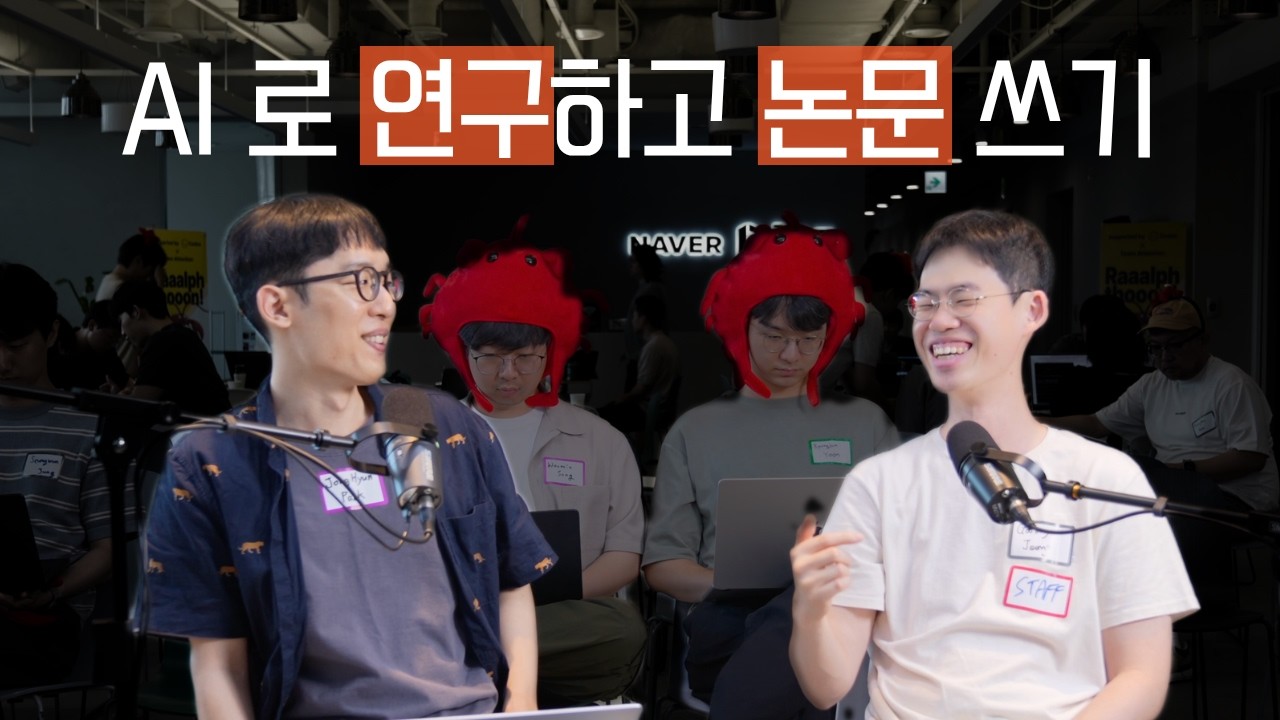
The best part was how Track 2 was won. From organizer Goobong Jeong’s recap:
“Each review agent had to review 10 of the Track 1 papers. The team whose scores had the highest correlation with the human judges’ scores on those same papers got a wildcard slot — and that wildcard won Track 2.”
— Goobong Jeong (Team Attention, Ralphthon organizer), translated from his recap
There is no way to grade the quality of a review directly. So they scored alignment with the human judges, and among teams screened on paper by their approach, the wildcard that got in on measured performance — winning team ‘MAC n CHEESE’, which detected hidden prompt injections and calculation errors in papers and ensembled multiple AI reviewers — actually won. Even “good evaluation,” seemingly unverifiable, was turned into a reward via alignment with humans.
Conferences are heading the same way. AAAI-26 gave all 22,977 papers an AI review, and authors preferred the AI reviews to human ones on technical accuracy (with gameability warnings alongside).
Trying to evaluate research with AI is itself the “let’s build a better reward” direction — and right now, everyone is pushing that way.
Dwarkesh ① Grant Sanderson: math, and taste
Three years ago, Dwarkesh asked: if AI wins IMO gold, isn’t that just AGI?
“You said it’ll be another benchmark, like all these other benchmarks that AI are passing.”
— Dwarkesh Patel, recalling Sanderson’s answer from three years ago
“The dirty secret with the IMO is that you really can train for a lot of them.”
— Grant Sanderson
The gold medal did arrive, and the take stands: one more benchmark fell. The AI frontier is spiky, and the spikiness is fractal — even within math, geometry falls in nineteen seconds while combinatorics still holds out.
“If you wanted to do a verification loop on whether group theory is an interesting concept… potentially that verification loop is a hundred years long.”
— Dwarkesh Patel
From Galois’s group theory through cryptography and physics to Gell-Mann predicting quarks: a hundred years. The exact opposite time scale from RLVR’s instant grading.
“Good mathematicians prove theorems, great mathematicians come up with conjectures, and the greatest mathematicians come up with definitions.”
— an aphorism Sanderson re-quoted
Today’s benchmarks grade only the first. As for the instinct behind Galois’s “I think there’s something here” — Sanderson says he doesn’t know how to make that a benchmark either.
Can AI actually do good research?
Can an LLM trained inside the whole of human knowledge step outside of it?
It looks possible to me. Research is drawing inspiration from isomorphic structures in other fields, and building new explanations out of contradictions between existing findings.
That ‘isomorphism across fields’ — in Sanderson’s words, a lightning bolt.
“You have this very small idea that has the form of expertise in one field and expertise in another, drawing a little lightning bolt between them.”
— Grant Sanderson
Number theorist Montgomery describes the correlation formula for the zeros of the Riemann zeta function, and physicist Dyson replies — “I know that expression. That expression comes up in studying the eigenvalues for random Hermitian matrices.” A lightning bolt hiding between number theory and nuclear physics. If AI’s discoveries take this form, humans can digest them easily — and there is plenty to mine just by connecting ideas already in the literature.
Dwarkesh ② Adam Brown: how far without experiments?
- General relativity was reached from almost nothing — the speed of light plus the equivalence principle (an unexplained ‘coincidence’) — an extreme outlier, and the archetype of research built on a contradiction in existing findings
- Branching fraction: fields differ in how much experiment it takes to prune the tree of theories — in condensed matter physics, you simply have to run the experiment
“If you just had lots and lots of Einsteins and you gave each of them various options, you could presumably see them in parallel.”
— Adam Brown
“They just have extreme patience, even for doing things that perhaps look like a low probability of success.”
— Adam Brown
Humans don’t spend time refuting conjectures they believe to be true; LLMs happily ‘waste’ that time. The same idea as the reproducibility challenge giving falsification 2 points.
Wrap-up: how will research change?
- Speed differs by field — math and ML, where verification is mechanical, move first; where experiments are the bottleneck, lab automation sets the pace
- Evaluation changes from the verifiable end — reproducibility becomes a reward first, and AI reviews become the first-pass filter
- But human evaluation was always error-prone — PPO’s worth was judged not by reviewers but by the LLM era, nine years later
- What remains until the end is taste — theorem-proving AI is here, conjecture-making AI is coming. So whose job is making definitions?
We continue this conversation in the next episode.
Listen to the podcast — EP 105 transcript
This piece is a written write-up of the conversation in EP 105 “Can AI Do Research?”. Jump straight to the matching part of the transcript:
- Case 1 — The Rejected PPO Paper and the Limits of Peer Review (0:30)
- Cases 2 & 3 — arXiv and Conferences in the Age of AI Slop (2:54)
- Attempt 1 — Reproducibility: The Hugging Face Reproduce Challenge (10:04)
- Attempt 2 — Inside Research Ralphthon (12:27) · Review Agents and the Problem of Reward Design (16:40)
- Dwarkesh ① — Dwarkesh × Grant Sanderson: Math and AI (18:38) · An IMO Gold Medal Is Not AGI (20:13) · Galois Theory and a 100-Year Verification Timescale (24:27)
- Dwarkesh ② — Adam Brown: The View That Compression Is Intelligence (30:51) · Theory Without Experiments: Physics and LLM Exploration (33:44)