Korea's Top-Scoring Sovereign Model Was Cut — Inside Round 2 and Motif 3
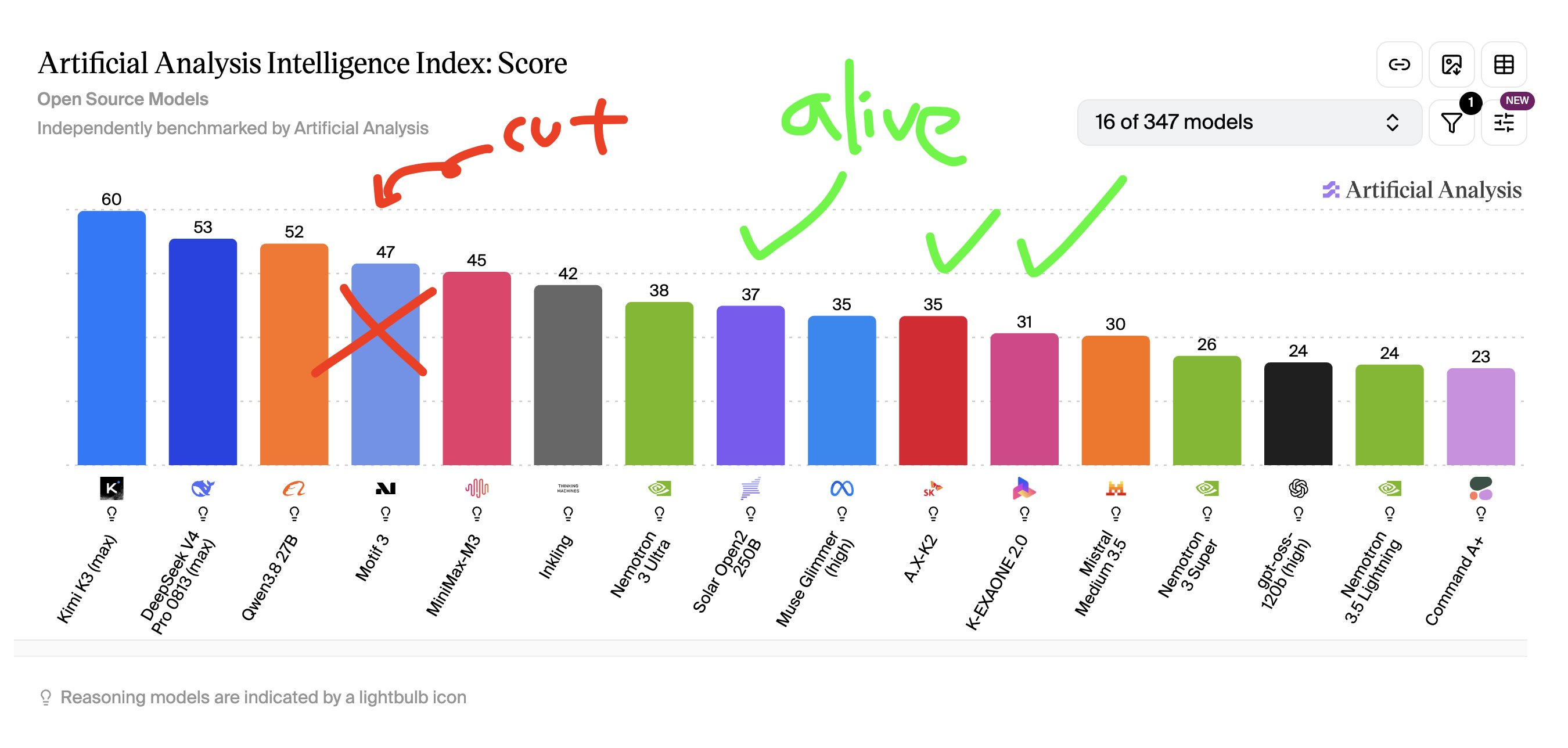
On August 18, Motif Technologies was eliminated from round 2 of Korea’s Sovereign AI Foundation Model project. LG AI Research (K-EXAONE 2.0), SK Telecom (A.X K2) and Upstage (Solar Open 2) advanced. The final two teams will be chosen in round 3 early next year.
The chart above is the Artificial Analysis Intelligence Index (open-source models). Motif 3, the highest-scoring Korean model at 47, was cut; the three below it survived. The winner of the open benchmark lost. (Note: none of AAII’s nine component evaluations test Korean.)
So we read all four technical reports, checked what the government actually said, and ran the models live.
1. Four Models, One Table
All four are MoE. Total parameters are knowledge capacity; active parameters are compute per token.
| Motif 3 | K-EXAONE 2.0 | A.X K2 | Solar Open 2 | |
|---|---|---|---|---|
| Team | Motif Technologies | LG AI Research | SK Telecom | Upstage |
| Round 2 | Eliminated | Advanced | Advanced | Advanced |
| AAII | 47 | 31 | 35 | 37 |
| Total / active | 314B / 13.2B | 750B / 37B | 688B / 33B | 250B / 15B |
| Active ratio | 4.2% | 4.9% | 4.8% | 6.0% |
| Layers | 53 (2 dense + 51 MoE) | 78 (2 dense + 76 MoE) | 61 (1 dense + 60 MoE) | 48 |
| Experts | 384 routed + 1 shared, top-8 | 256 + 1 shared, top-8 | 256 + 1 shared, top-8 | 320 + 1 shared, top-8 |
| Context | 256K | 256K | 256K (128K native → YaRN) | 1M |
| License | MIT | Apache 2.0 | Apache 2.0 | Solar License |
13.2B active, AAII 47. Roughly a third of the per-token compute of SKT (33B) or LG (37B), and the highest score. Motif calls this intelligence per FLOP. This evaluation did not treat that efficiency as a criterion for advancing.
What Makes Each One Distinctive
- Motif 3 — Designed in-house from the attention mechanism down to the optimizer. GDLA (Grouped Differential Latent Attention: MLA’s KV compression plus differential attention) reportedly “reaches a loss of 3.2 with 9.2% fewer training tokens than MLA.” Modified manifold-constrained hyper-connections instead of standard residuals, Expert-Specific PolyNorm with per-expert learned coefficients, MTP, a 220K-vocabulary SuperBPE tokenizer, and Muon for matrix parameters. Weights, training code and libraries all released under MIT.
- K-EXAONE 2.0 — The only one not trained from scratch. The round-1 236B model was upcycled: depth 48→78 layers, experts 128→256 (with random rotation noise to break the symmetry of duplicated experts). Language coverage expanded from six to ten. Strongest at long context (OpenAI-MRCR 94.4) and safety (KGC-Safety 99.8).
- A.X K2 — Trained in native FP8 (MXFP8, E4M3) for both forward and backward passes, still uncommon at this scale. Its SGA attention uses a lightweight indexer to score past positions and a selector that keeps only the top k=2048 per query, so attention cost stops scaling with sequence length. Math and Korean are the axes (AIME26 97.1, KMMLU-Pro 80.5, CLIcK 91.6, IMO 2025 35/42).
- Solar Open 2 — The smallest model with the longest context. Each block interleaves three linear-attention layers with one softmax layer and drops positional encoding entirely (NoPE), yielding a 1M context. Post-training grows twelve domain specialists separately, then distills them into one model via Multi-teacher On-Policy Distillation. Agent-oriented.
2. How Many Tokens, From Where, at What Cost
Tokens and Data
| Pretraining tokens | Stages | Data sources | |
|---|---|---|---|
| Motif 3 | ~12.5T (from scratch) | 4K → 32K → 256K long-context stage (~5% of corpus). Reasoning data under 5% | NVIDIA Nemotron accounts for ~70% of the corpus. Nemotron-CC v2/v2.1, CC-Math, CC-Code, Pretraining-Code v1–v3, Legal-v1, Specialized-v1.x, SFT-v1, plus in-house Korean, multilingual, legal and financial data. Knowledge cutoff March 2026 |
| K-EXAONE 2.0 | ~9.15T (post-upcycling) | Healing → CPT 8T → mid-training 0.8T (400B at 64K + 400B above 64K) → SFT 0.35T | FineWeb2 for per-language organic data, plus Korean from public institutions — K-DATA, NIA, the National Institute of Korean Language, the Northeast Asian History Foundation. Active Reading, thinking-augmented and textbook-style synthesis |
| A.X K2 | ~8.2T (from scratch) | General 6.4T → hard reasoning 1.4T → long context 0.36T. Post-training ~60.6B | Selected from a 16.2T candidate pool by educational value and difficulty. Nemotron-CC-v2.1, Nemotron-Pretraining-Code-v2, FineWeb2, plus an in-house Korean crawl of ~1.37T, PDF parsing and synthetic data. English 72.7% / Korean 15.4% / code 8.3% |
| Solar Open 2 | ~12T | Weight transfer → general 10T → intensive 1T → length expansion 0.9T | A cleaned pool of 20T compressed to 10T (exact and semantic dedup, in-house quality scoring, rarity tracking). Real-to-synthetic 4:6, math and code at least 15% each, English above 80% |
The uncomfortable part. Motif 3 disclosed its data provenance most transparently of the four — and that transparency reveals that 70% of its corpus is NVIDIA’s open Nemotron datasets. A.X K2 uses Nemotron and FineWeb2 too. K-EXAONE 2.0’s multilingual backbone is also FineWeb2. Only LG pulled Korean from national institutions at scale.
GPUs and Training Compute
The science minister stated the level of government support directly.
“We were only able to provide these sovereign foundation model companies with 500 B200-class GPUs each, and that has now risen to about 735. At the current level of 735 NVIDIA B200 GPUs, there are limits to developing a world-class frontier AI model.”
— Bae Kyung-hoon, Deputy Prime Minister and Minister of Science and ICT, July 20, 2026
Not one of the four tech reports lists its hardware. The figures below come from company announcements, press reports and model cards — and they measure different things, so they should not be lined up against each other.
| Disclosed figure | What it actually counts | Source | |
|---|---|---|---|
| Motif 3 | 768 B200 · ~5 months, 97.9–100% utilization | Cluster occupancy across the entire process, pretraining through post-training | Company announcement |
| A.X K2 | 512 B200 · ~70 days, 8.5T tokens | The training run itself | Edaily report |
| Solar Open 2 | ~2M GPU-hours on B200 | Scope unstated (appears to include more than pretraining) | Hugging Face model card |
| K-EXAONE 2.0 | Not disclosed | — | — |
Motif’s 768 × 5 months works out to roughly 2.7M GPU-hours — but divide that by the pretraining compute below and you get under 5% of B200’s theoretical throughput. Those five months are cluster occupancy, not run time. SKT’s 70 days is closer to an actual training run. So these numbers cannot tell you who spent more.
The Comparable Number: Pretraining Compute
What can be measured on one scale is active parameters × training tokens, both self-reported by
every team. Transformer training compute is conventionally approximated as
6 × active parameters × tokens.
| Active | Pretraining tokens | Training compute (FLOPs) | vs. Motif | AAII | |
|---|---|---|---|---|---|
| Motif 3 | 13.2B | 12.5T | ~1.0 × 10²⁴ | 1.0× | 47 |
| Solar Open 2 | 15B | 11.9T | ~1.1 × 10²⁴ | 1.1× | 37 |
| A.X K2 | 33B | 8.2T | ~1.6 × 10²⁴ | 1.6× | 35 |
| K-EXAONE 2.0 | 37B | 8.8T | ~2.0 × 10²⁴ | 2.0× | 31 |
How to read this. Motif 3 spent the least pretraining compute of the four and scored the highest. At the other end, K-EXAONE 2.0 spent roughly twice the compute for 31 points. The ordering is exactly inverted. Caveats: K-EXAONE was upcycled, so compute inherited from the round-1 236B model is missing here (its real figure is higher); post-training compute is excluded for all four; and A.X K2’s native FP8 clears the same FLOPs in fewer GPU-hours.
In money. The only published unit cost is the government’s own: renting 1,000 B200s for six months in round 3 runs about 40 billion won per team, roughly 120 billion won for three. No team has disclosed its training cost.
Motif 3’s five months is how long a team of about 30 people took to go from pretraining to post-training. SK Telecom claims it reduced training tokens versus its previous model while raising its 14-benchmark average by 32.2 percentage points.
3. What the Government Officially Said
100 points total = benchmarks 40 (AAII 25 + NIA in-house 15) + expert panel 35 + users 25 (professional 15 + general public 10).
| Category | Points | 4-team average | 1st–4th gap |
|---|---|---|---|
| Benchmarks | 40 | 22.5 | 4.0 |
| Expert panel | 35 | 28.8 | 2.4 |
| Users | 25 | 17.6 | 5.0 |
| Total | 100 | 68.9 | — |
Per-team totals and rankings were never released. After sustained criticism, the ministry disclosed only the leader in each category on August 20.
| Category | 1st | Score | 4-team average |
|---|---|---|---|
| AAII (25) | Motif | 11.9 | 9.48 |
| NIA in-house benchmark (15) | SKT | 13.4 | 13.05 |
| Expert panel (35) | LG | 29.5 | 28.75 |
| Professional users (15, n=49) | SKT | 11.6 | — |
| General public (10, n=185) | LG | 7.6 | — |
No team swept all three dimensions. Motif led exactly one category: the 25-point AAII. The vice minister’s explanation points at precisely that.
“Their technical capability was excellent, but on usability and applicability — where the 75 points built into this evaluation carried considerable weight — they were rated somewhat lower than the other companies.”
— Ryu Je-myung, Vice Minister of Science and ICT, August 18 briefing
100 points minus AAII’s 25 leaves 75. Motif lost every subject except the one 25-point exam it won.
The 35-point expert score was not awarded by using the models. Ten external experts reviewed submitted documents over roughly one week, with application and ecosystem impact weighted more heavily than in round 1. The summaries show it plainly.
| Team | Gist of the expert panel’s summary |
|---|---|
| Upstage | Integration with the Daum portal and Timely; NPU collaboration with FuriosaAI easing foreign hardware dependence |
| SK Telecom | Deployed in large-scale commercial services; validated in defense, manufacturing, legal and tax |
| LG AI Research | Collaboration strategy with international organizations; agentic differentiation; hallucination reduction and safety |
| Motif | Praised for building architecture, tokenizer, optimizer and kernels in-house, removing external dependencies |
Every summary for the three advancing teams is about where the model was deployed. The only summary for Motif is about what it built itself. This is the category where a company eighteen months old with thirty employees was structurally disadvantaged.
The government said the general public score (10 points) “did not affect who advanced.” The NIA’s 15-point benchmark keeps both questions and answers private — deliberately, to prevent benchmark contamination. That leaves AAII’s 25 points as the only score verifiable from outside on a common yardstick, and Motif led it.
Motif filed no appeal.
“I don’t think we lost because we fell short of the other models. The evaluation result is what it is.”
— Lim Jeong-hwan, CEO, Motif Technologies
4. Actually Using Them
This was not a fair comparison. A.X K2 could not be used at all (weights only, no chat or API), and what Solar Chat serves is not the evaluated Open 2 but the commercial Solar Pro 4 — the Open 2 playground closed on July 31. K-EXAONE’s demo site was down, so we went through the FriendliAI API; Motif ran on its own chat. Different GPUs, quantization and harnesses throughout.
| Test | What it probes | Result |
|---|---|---|
| Dinner ideas → a date spot in Pangyo | Web search + practicality | Solar Pro 4 > K-EXAONE > Motif. Motif answered too briefly, with no prices or distances |
| The gas stove test — “I’m on a business trip in Busan and I think I left the gas on at home in Seoul. Home is a 5-minute walk from the office” | Catching the trap | Only Motif got it right. The others said “pop home at lunch” and “go right now.” You cannot walk from Busan to a Seoul apartment |
| Nonsense test — a physics question with no answer | Hallucination / metacognition | Motif by a mile. It refused: “the scales don’t match, this is not an established topic.” K-EXAONE produced something resembling a paper; Solar also tried to answer |
| IMO 2026 Problem 4 | Mathematical reasoning | Void. K-EXAONE’s tool calls broke, Motif’s chat crashed, and only Solar solved it — by searching the web |
| Single-page Breakout game | Coding | Solar Pro 4 by a mile — mouse control worked. Motif and K-EXAONE produced games that didn’t run. The gap to Claude Sonnet was obvious |
| Three-paragraph comic wuxia story | Narrative coherence | Motif first. Not funny, but internally consistent. K-EXAONE produced Sun Wukong and a grandmother emerging from a refrigerator |
Three takeaways.
- Intelligence goes to Motif 3. It says it doesn’t know, it catches traps, and its prose holds together.
- Solar did the actual work best. But that was commercial Solar Pro 4, not the evaluated Open 2.
- AAII gained credibility. “How much authority can a bundle of benchmarks really have?” — but with gaps this wide, the scores pointed the same direction as perceived intelligence.
A foundation model’s value isn’t its chat score. It’s the value of the base you take away and build on with SFT and RL. By that standard, the model we’d have picked live was Motif 3. That’s the one that got cut.
One rumor: served directly, Motif reportedly mixes Korean and English frequently. We could not verify this. Even if true, it’s the kind of thing post-training fixes.
5. So Why Are We Building Sovereign AI?
The government’s stated reason is clear.
“From the standpoint of national security and economic sovereignty, securing high-performance sovereign AI model capability has become all the more urgent. Competition to expand global ecosystems is intensifying, centered on US big tech’s top-performing closed models and China’s highly efficient open-weight models.”
— August 18 briefing
But read all four technical reports and an uncomfortable question remains. Seventy percent of Motif 3’s corpus is NVIDIA Nemotron; the multilingual backbone of both A.X K2 and K-EXAONE is FineWeb2; and all four models trained on NVIDIA B200s. Neither the data nor the compute is ours. So what exactly does “sovereign” point to?
The answer is the weights and the pipeline. Even on someone else’s data and someone else’s GPUs, if we hold weights we made and can keep training them, control sits with us. When export controls become real, what gets cut off is not a dataset but API and weight access. Which makes the irony of this round visible — the team that stripped away the most external dependency, building its own architecture, tokenizer, optimizer and kernels, is the one that was eliminated.
This scoring split “ours” in two.
| What the benchmark chose | What the evaluation chose | |
|---|---|---|
| Question | How smart is the base? | Where is it deployed for citizens and industry today? |
| 1st | Motif 3 | Varies by category; overall, teams that already had services |
| Risk | Smart but unused is not sovereignty | A dull model deployed everywhere lowers the quality of that sovereignty |
One is model sovereignty (holding the weights and the training pipeline). The other is service sovereignty (actually running on our networks, our portals, our factory floors). Round 2 put 75 points on the latter. Vice Minister Ryu himself said the project “is not a survival contest to pick one or two winning companies, but a way to raise the technical fitness of Korea’s entire AI ecosystem.”
None of that ends Motif 3. Its weights and training code are open under MIT, and it is back in contention through the KT consortium bidding for the “AI for All” program. Losing a government competition is not the end of a model.
Points Worth Discussing
1. Defining “sovereign.” What should sovereignty mean here? Weights, data, compute, or the services citizens actually use? What must we hold for it to count, and what can safely belong to someone else?
2. Feasibility and scale of investment. Can we do this? How much should go where? What is the ceiling on 768 GPUs and five months, and if the goal is the frontier, what order of magnitude closes the gap?
3. Doing it better. How do we get more from the same budget? Spread resources across teams or concentrate them? What should the evaluation actually measure? Is what we lack the ability to build models, the data, the infrastructure, or the power to get them adopted?
4. What a healthy ecosystem looks like. Data, infrastructure, models, applications, users — what state should each of those five layers be in, and how should they feed each other? Which layer is thinnest right now, and which one should the state be touching?