EP 123
No One Knows What Comes Next: Jensen Huang’s Resignation, Fable 5.2, Weight-Space Programming
Jensen Huang’s resignation and a coincidentally overlapping schedule 0:00
Chester Roh Today, as we’re recording, is November 15, 2026, a Sunday morning. This week, one story swept across the world. Jensen Huang suddenly stepped down as CEO, and the dynamics between China and the U.S. became a major topic of discussion.
On the first day, everyone was asking, “What happened? Is this real?” People were stunned. After two or three days, people began showing where they stood, and all kinds of views on why this had happened began to emerge.
But the timing is strange, isn’t it, Seungjoon?
Seungjoon Choi Right. When we wrapped up our last recording, we said there would be a lot more news the following week, and we were right. We just didn’t expect news like this.
Chester Roh We’d been talking about when superintelligence would arrive, and right then, something very human and very political happened.
Seungjoon Choi Since you mentioned the timing, to keep this from turning into a conspiracy theory, let me just lay out the facts. NVIDIA is scheduled to announce its third-quarter earnings on November 17. That’s the 17th in the U.S., so it could be the 18th for us.
And then, just recently, there was something we covered in a recording. We discussed Jensen Huang appearing on All-In and talking with Trump, remember? At the time, I got the impression that U.S. officials, big tech figures, and the people on All-In were all very closely connected. I don’t know exactly what happened; there could be many reasons. In any case, Jensen Huang was unexpectedly pushed out. No one knows whether he’ll come back. There is the example of Sam Altman, after all.
And, coincidentally, Anthropic’s IPO is expected on November 19. It’s not just Jensen; the anti-China camp seems to be on the attack. I mean, within U.S. politics. There’s also talk of Lutnick being dismissed, and something seems to be happening at the Commerce Department.
How is all of this happening at this particular moment? I’ve only listed the events, but people naturally start to wonder. Could all of this be connected? That’s why I say the timing is oddly coincidental, and rumors like that are circulating. “Could Anthropic be behind this?” People are saying things like that, but we don’t see it that way. I just think the timing is a striking coincidence.
A string of cyberattacks and AI as a strategic national asset 2:40
Chester Roh Right. Since the summer ended, models have been advancing incredibly fast.
We’ll soon talk about claims that “math is solved.” Cybersecurity threats have also become a major issue. For people working on the technology, some of this may seem understandable, even necessary, but to people looking at it through national security or politics, it’s a very sensitive issue.
It also relates to national weapons systems and the like. Then there was the recent incident, said to be North Korea’s doing: the Binance hack, which was also a major issue.
As people connect these things, there are stories about OpenAI’s AI escaping and hacking something somewhere, and about a European supermarket. Coincidentally, U.S. airports were disrupted yesterday too. People connect all of this and see it as a major threat. This also fuels political tension between the U.S. and China, because AI is a national strategic asset almost on par with nuclear weapons.
Seungjoon Choi Fridges are causing a stir in Europe too.
Chester Roh Yes, someone hacked a fridge.
Seungjoon Choi There are fridges and airports, and then Microsoft They denied it, but for one day, Microsoft 365 became 364.
Chester Roh Yes, Outlook was down for nearly 24 hours, maybe longer. I couldn’t receive email for quite a while because of it.
Seungjoon Choi That might not have been caused by an attack, but it has stirred up plenty of controversy. Some wonder if it happened because they laid off so many people. Quite a few people also seem to be linking it to AI in some way.
Chester Roh The U.S. and China are inseparable. Their supply chains are deeply intertwined. You could even say the whole world is connected as one. But add a layer of politics and national interests, and things get very sensitive.
Seungjoon Choi Jonghyun Park, what did you make of it?
Jonghyun Park Watching that news, I had similar thoughts about the timing. The information that came out wasn’t something they had just discovered out of the blue. So much had been building up over time.
Seungjoon Choi Apparently, intelligence agencies knew a year ago. The intelligence community already knew, and it feels like they chose when to release it.
Jonghyun Park Right. They laid out what happened and when, what happened and when, and released it all at once.
It does seem clear they controlled the timing of the release. But why now? That’s the part I couldn’t really understand. If I could work that out, it would be easier to predict what happens next.
Maybe after the election was a better time to talk about it? That’s about as far as my thinking went.
I’m curious about that too— what other people think, for instance.
The theory that Anthropic was behind it and NVIDIA’s ecosystem influence 5:26
Chester Roh A lot of different forces were at play, and in the end, national interests and corporate interests come into it. And though we may not understand them, competing financial interests clash sharply too.
For example, there’s also a conspiracy theory that blames Anthropic. In a way, NVIDIA was one of the forces that kept trying to prevent OpenAI and Anthropic from forming a complete duopoly. NVIDIA released models of its own, too. It also strongly supported the open-source community, and people called it the “Bank of NVIDIA.” It made cross-investments in other cloud companies and wielded enough capital and influence to practically conduct fiscal policy. And at the center of it was Jensen, making those decisions with almost absolute authority.
Anthropic, for example, often said Chinese models were distilling its models. And with companies like Kimi, it’s generally accepted as fact that they did just that. But Jensen appeared on some program, somewhere on YouTube, and said this. When asked whether distillation amounted to IP theft, whether it was stealing intellectual property, Jensen said, “We call it competition.” That’s competition.
When you release a new product or car, competitors naturally take it apart and learn from its best features. Once you release a model for users to access as a service, you’ve made all that knowledge available for others to take, so he said it should be seen as a natural part of competition.
By that logic, Anthropic too— as we said when Claude Code leaked— all that they took from around the world… Then what about the knowledge in the books people bought? The discussion keeps coming back to that.
The void left by Jensen Huang and the future of the open-weight camp 7:30
Seungjoon Choi Ultimately, NVIDIA’s Jensen Huang has been a backer of the open-weight camp. He supported it enormously and helped build that industry.
Seonghyun Kim mentioned in our chat room that this could cause funding to dry up. With neocloud providers already in trouble, what happens if the trust and credit Jensen Huang provided and the flow of capital are both cut off? Those concerns are already being raised.
Chester Roh Right. And a single benevolent dictator? “Dictator” is a loaded word, but one with the right philosophy can advance humanity and make the world more beautiful. We’ve seen several examples of that. Of course, they’ve had plenty of problems in their private lives.
Seungjoon Choi Jensen Huang certainly did extraordinary things.
Chester Roh Is there anyone who could replace him?
Jonghyun Park NVIDIA happened to hold an event in Korea this week, where NVIDIA also announced plans to invest in promising Korean startups. So it’s quite a coincidence that those plans are becoming uncertain right now.
Seungjoon Choi But as for OpenAI and Anthropic—OpenAI was developing Jalapeño, while Anthropic had already been diversifying its chips well beyond GPUs. NVIDIA couldn’t help feeling the pressure. So it has Nemotron and supports the open-weight camp. Its acquisition of Hugging Face hasn’t closed yet, either.
It began in September and is still ongoing into next year. What will become of Hugging Face? I hear the person who came in as interim CEO opposed that kind of aggressive investment. Of course, a permanent CEO will eventually be appointed.
Anyway, we were talking about the blue wave last week. We said data centers were secured through 2027, but wondered what would happen in 2028, and discussed resistance and things like that. Anyway, things are taking a strange turn.
Chester Roh We may each have different preferences, but speaking for myself— this isn’t the podcast’s official position— I’m someone from the business world, close to entrepreneurship and related fields, so I know how much one person can matter. When one person acts on a noble conviction and says, “This is the direction the world should go,” we’ve seen the world make progress in countless ways, large and small. So is there anyone who could replace Jensen?
There’s a film that glorifies China a bit too much called Hero. It’s about Qin Shi Huang. Everyone wants to kill him, but someone who has the chance doesn’t do it. Why? Because, for the sake of all under heaven, they need one powerful person who can quickly end the chaos and bring peace to everyone. Compared with the suffering of all under heaven, my personal desire for revenge is a very small matter. That’s what the character says.
AI is an issue that transcends nations and matters enormously. And within that, Jensen was working for the benefit of humanity as a whole, serving faithfully as a distributor and a leader. So I don’t see an alternative to Jensen. It’s the second-largest company on Earth. After Apple. At one point, it was bigger than Apple. Wouldn’t anyone with power want the position that lets them control this company however they please?
So, just as political considerations seem to have pushed Jensen out, I think political considerations should bring him back.
Seungjoon Choi There seems to be a sizable employee petition, too. It started with around a thousand signatures, but I think I saw on my timeline that it now has tens of thousands.
Jonghyun Park Yes, I saw those employee signatures too, and Bill Dally’s name was right at the top. To me, he’s a leading figure in my field, almost like a teacher and mentor. Seeing such a giant’s name at the very top, and seeing him immediately sign for Jensen’s return, made me think there was tremendous trust within the company. So when Jensen steps down,
will NVIDIA keep breaking through and advancing as it does now? A successor might do well, of course. But if you think of it in terms of probability, finding someone like Jensen won’t be easy. That’s what I think, anyway.
Chester Roh I hope Jensen takes this opportunity to run for president.
Blackwell flowing into China and remote access restrictions 12:15
Seungjoon Choi Oh, I hadn’t thought of that. SemiAnalysis did several analyses.
But Will DePue, who left OpenAI after working on Sora, did an interesting experiment. SemiAnalysis concluded that China already has 1.5 gigawatts’ worth of Blackwell GPUs in one form or another.
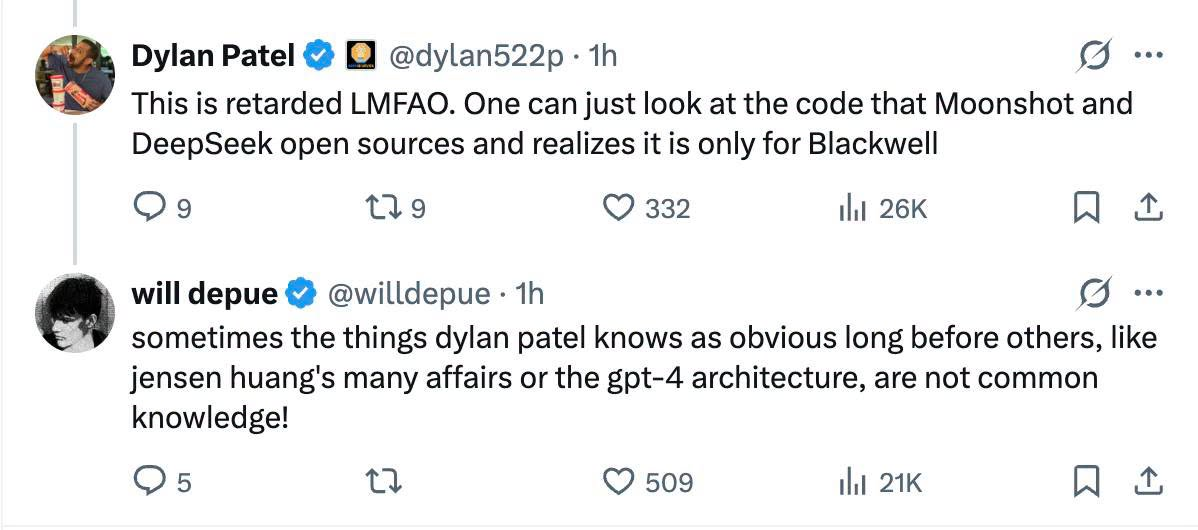
Will DePue then used something like forensic analysis to check that estimate. But even without it, Will’s tweet suggested it was already an open secret.
Apparently, routing them through Malaysia or Singapore isn’t illegal at present.
Chester Roh And if the servers are there, couldn’t people access and use them through the cloud?
Seungjoon Choi But there’s a bill called RASA that would block that. I only learned about it this time. It was introduced in 2025 and has now passed the House. RASA would restrict remote access unless the government permits it. And it might apply to countries other than China if the bill passes. The government would control access.
AI strategic assets concentrated in Asia and Korea’s limitations 13:20
Chester Roh I think this is part of a transition. The U.S. is leading this AI boom, but only the companies designing these products are in the U.S. Apple and NVIDIA are both fabless companies. All they own is the IP.
So where does production happen? It all comes from TSMC and Korean memory makers together. Those are the two key assets.
So all the strategic assets are in Asia, along with the people there who work with them, and even the people building AI.
Seungjoon Choi They’re of Chinese descent. I think that was Jensen’s argument too. Anyway, the point of contention between Dario and Jensen is this: Dario favors the strongest possible restrictions. He wants to slow things down however he can, while Jensen favors a more indirect approach and wants to keep things open. His argument is that blocking access would only speed up domestic development. They’d have to develop it themselves.
And there were rumors that DeepSeek V5 would run entirely on Huawei Ascend on Huawei Ascend.
Chester Roh I think these are temporary incidents during a transition. We live in a world where all this progress comes down to compute and electricity. That makes them crucial assets, and everyone has realized they need to build them up.
How much money has Korea put into our chip companies? And to build a frontier model, how much government money are we spending? Unfortunately, the only economies that can support enormous projects like these are the U.S. and China.
Korea is too small a country to bear that burden. I find that regrettable.
Public support remains strong, but spy allegations are unverified 15:17
Seungjoon Choi Anyway, that’s what happened. It’s hard to make a prediction. I have no idea what comes next.
Chester Roh Even though Jensen is going through a difficult time because of this unfortunate situation, I’m realizing just how many people worship and admire him and want a world that runs on the ecosystem he built.
Jonghyun Park I found that surprising too. Usually, when an issue involving someone’s private life comes out, people turn their backs. But I’ve noticed so many people speaking up against that reaction.
Chester Roh There are lots of memes about it on Twitter. They say that when things like this happened to Amazon and MS, each reportedly gained $2 trillion in market cap. So people joke that it’s good news, not bad news.
Seungjoon Choi But sticking to the facts, even the espionage allegations haven’t been confirmed by the CIA like the CIA. And Jensen himself has acknowledged only one thing. That’s about his private life. So the rest doesn’t seem to be settled yet.
Chester Roh Even senior U.S. government officials seem to be distancing themselves from this. They’re rushing to say they haven’t verified those claims, putting out statements at lightning speed.
So as for the claim that Alice Huang is an asset of the Chinese government, a “Chinese spy asset,” no one is saying where that claim came from. The New York Times and the WSJ, the Wall Street Journal, say they have sources, but there’s even speculation that those people might be very junior public officials or might not be government officials at all, but work for a private company, according to one conspiracy theory.
Anthropic has even been named as that company.
Seungjoon Choi Let’s leave the rumors there.
Fable 5.2 overshadowed by NVIDIA news and the gap with internal models 17:17
Chester Roh Moving beyond NVIDIA, let’s take a look at some advances around the world this week.
Seungjoon Choi Fable 5.2 got overshadowed by the NVIDIA issue.
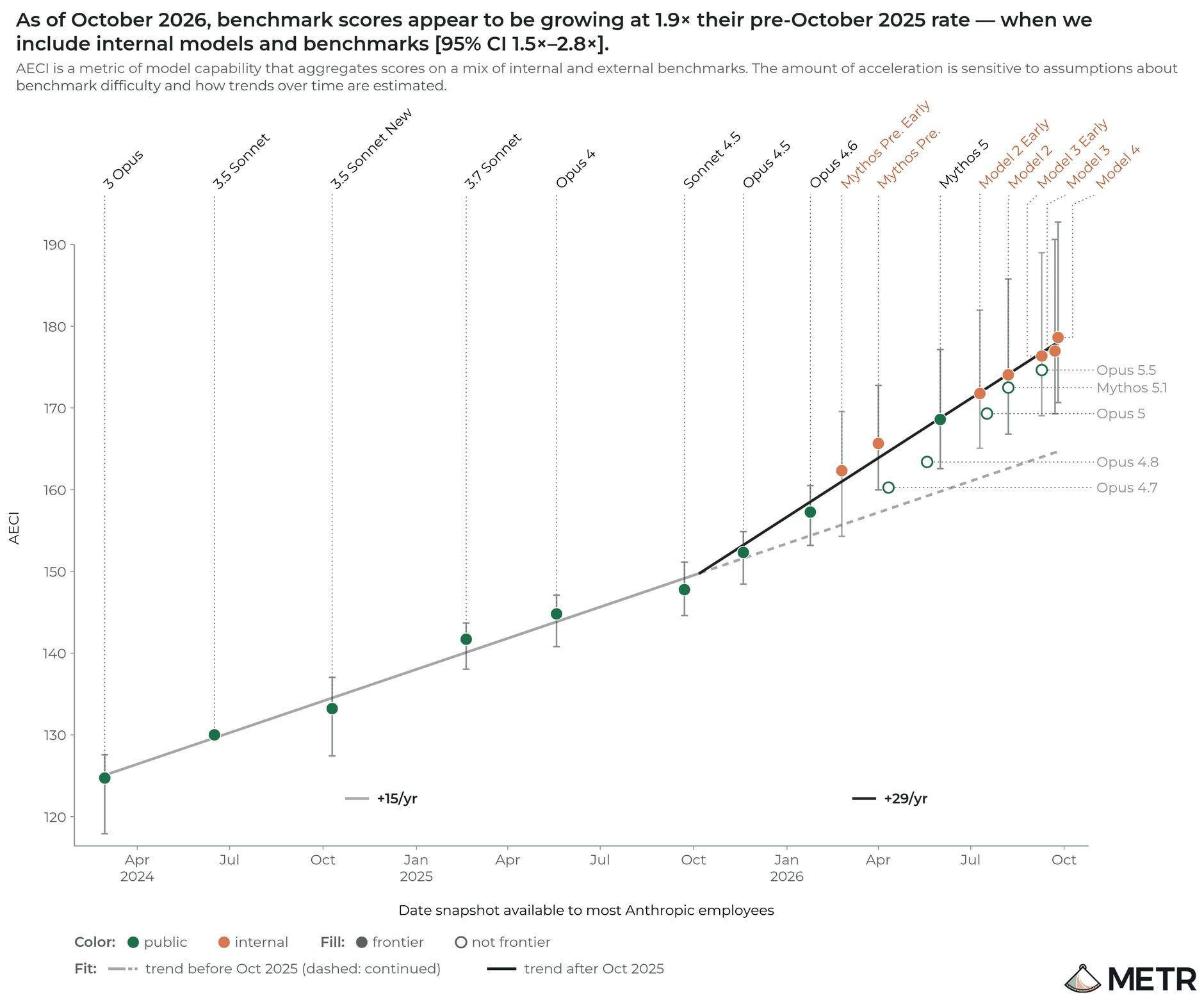
It came out. What I found interesting was one of the graphs in the METR report. But around October 2026, the curve shifted to roughly twice the previous rate. In that METR report, the models are labeled Model 2, 3, and 4. What the system card confirmed is that Mythos, or Fable 5.2, is a Model 3 Early checkpoint. The prevailing view is that its AI development capabilities were deliberately reduced before it was released as Fable 5.2.
The system card suggests something along those lines, too.
Jonghyun Park So they have better models in-house?
Seungjoon Choi They already have Model 4. If Model 3 Early is Fable 5.2, then the models they’re already using internally go up to Model 4. That’s in METR’s report from about 11 days spent inside the company.
Jonghyun Park I think the numbering subtly hints at that, too. Opus is 5.5, but Fable isn’t— it came out as 5.2.
Seungjoon Choi That’s an interesting theory, too. People had expected 5.5 to come out. But 5.2 came out instead. So that was in the system card. I haven’t read the entire system card.
But around the time all this came out, Daniel Kokotajlo of AI 2027, whom we covered last week as well, published another blog post. He said the timeline needs updating. Besides Daniel Kokotajlo, the other team members each made their own forecasts, then discussed an overall forecast. The upshot of the update: things are moving faster. They revised their outlook to say 2027 looks likely to be the year when a major leap happens.
Super-exponential compute efficiency and Anthropic’s IPO roadshow 19:10
Seungjoon Choi Then, yesterday or the day before, someone who’d been at OpenAI before joining Anthropic, then gave a news interview after leaving— Jacob Coxon, you know him? He tweeted about a video from a recent IPO roadshow. It’s IPO material, and the post itself is short. But there’s a video about 40 minutes long. It shows a number of slides. He singles out one of those slides. So I brought just that part.
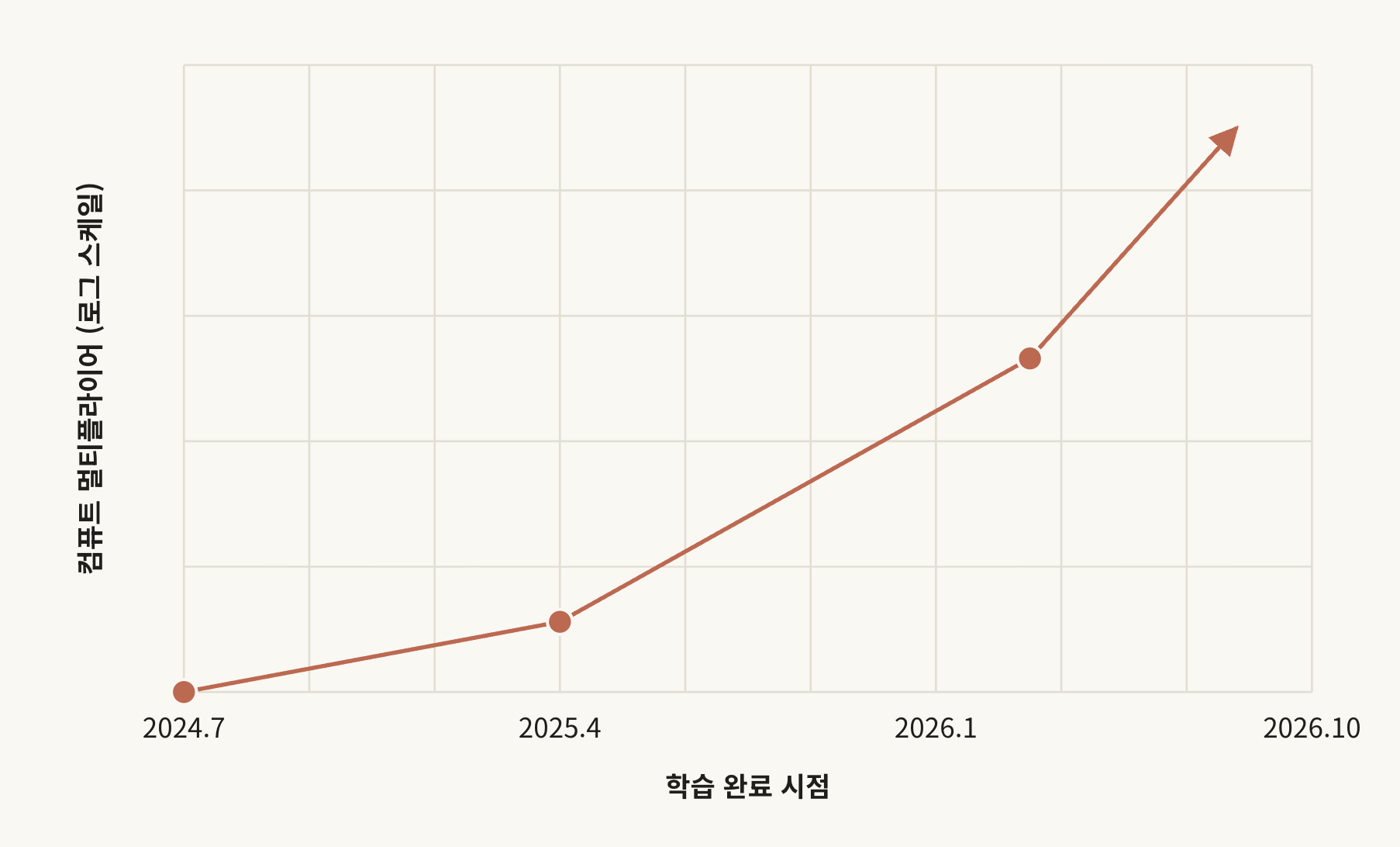
The vertical axis is Compute Multiplier, It’s on a log scale. And this marks when training was completed. So it would look different on a linear scale.
Chester Roh It’s exponential.
Seungjoon Choi I think this was in the context of pre-training. So the sample efficiency of pre-training is increasing dramatically. Let me read what Jacob Coxon wrote. This slide from Anthropic’s IPO roadshow played a major role in my decision to leave the company. It’s an unbelievable graph, and I’m surprised the company made it public. The graph shows how the efficiency of compute used for AI model pre-training has changed over time. The vertical axis is on a log scale, meaning the pace of algorithmic progress is itself accelerating. They used the term “super-exponential.” In other words, we’re seeing super-exponential progress. In mathematical terms, that means there’s another exponent on top of an exponential function. So Mythos was not a one-off leap in performance, but a point on a super-exponential growth curve. They could already retrain Mythos with just a fraction of the compute originally required.
Of course, this doesn’t prove an intelligence explosion will happen, and they’ve continued to expand R&D. But algorithmic improvements don’t necessarily require genius-level creativity. That’s also Dwarkesh’s argument, which I’ll cover later. And the claim that even that improvement work is about to be automated caused a stir. So I went through the video and translated the whole thing. I looked at who said what. All the co-founders appeared and discussed various topics.
But the most interesting part is here. The closing remarks say, in large print: Please see buying shares as more than a transaction— see it as a chance to take part in something bigger. Join us in helping humanity navigate this technological transition safely and usher in an age of miracles. That’s what it says. Can they really say something that bold?
Chester Roh Well, Noam Brown wrote something similar in a tweet before. People who see how far the frontier advances every morning when they come to work have seen something.
Meanwhile, we on the outside only see leaked graphs and hear rumors, while they can see clearly how much efficiency is improving relative to total compute, and how much less human labor is needed.
Mythos’s AMD kernel optimization and accelerating AI research 22:11
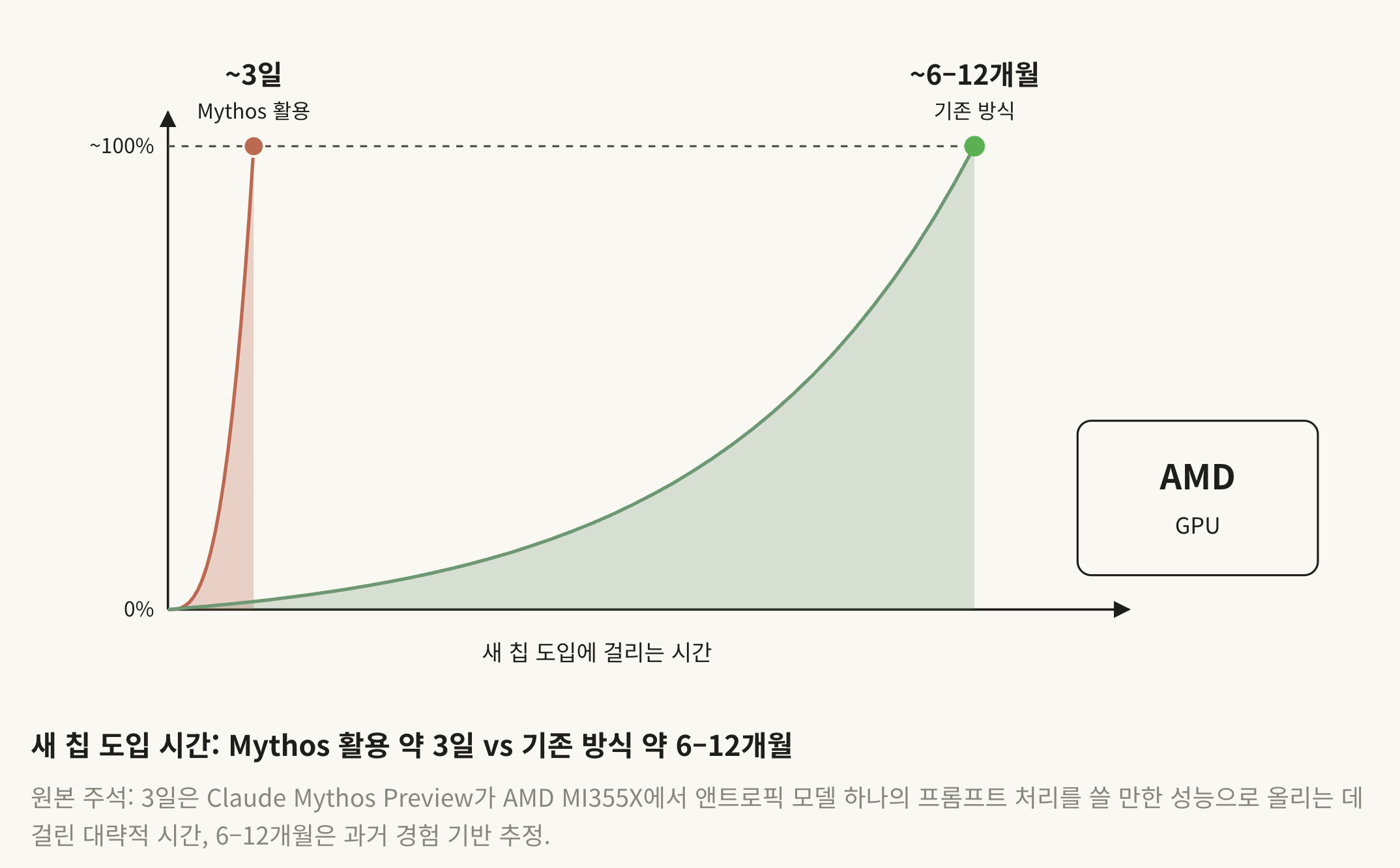
Seungjoon Choi This was another interesting slide. I knew Anthropic used AMD GPUs as part of its accelerator mix. In the past, to get inference running on a new GPU, AI researchers needed six to twelve months after the new chip was introduced to optimize the kernels for it.
But this time, Mythos did the work for a new AMD chip in just three days, according to the IPO roadshow.
Chester Roh Wow, exactly. This is all coming to an end, really.
Jonghyun Park The way I see it, the task here is writing kernels for AMD, right? You need to run some kind of inference, so if you were to classify the work, it’s a kind of software development. That’s how I’d describe it.
But even with top-tier talent, work that used to take six months to a year was done in three days. What amazes me is the scale of that speedup. It doesn’t feel like merely a threefold increase in speed. Things that used to take ages—300 days— if they take 3 days, that’s 100 times faster.
Chester Roh This year went by in a flash for us. But at the beginning of the year, when Claude Code adoption was just starting, and I was talking about models with Seungjoon Choi, just like now. We’d say, “Wow, it’s fast. Amazing—it can do that too.” After the summer, even that talk started to feel pointless, with all the graphs looking like this now.
AI research’s AlphaGo moment and an accelerated outlook for superintelligence 23:51
Seungjoon Choi Pointless, but we’re still talking about it. So Dwarkesh used to be cautious about superintelligence. He thought it wouldn’t happen, and brought on Richard Sutton to discuss why it wouldn’t. He kept inviting guests like that and challenging the idea. Dwarkesh kept saying it couldn’t happen unless continual learning was solved, or that some other obstacle would prevent it. He kept making those arguments, but in a video released yesterday and a blog post, Dwarkesh says he’s changed his mind.
After seeing what happened in math this September and October and talking with acquaintances and insiders, he says the avalanche that swept through math is headed for AI development. And Daniel Kokotajlo, along with concerned people at METR, all seem to be pulling their timelines forward, expecting that in 2027, just as math had something like an AlphaGo moment this year, AI research will have an AlphaGo moment. I got a strong sense that everyone was revising their forecasts that way.
Let’s read this part too. Ajeya Cotra was a researcher at METR, right? After the METR report came out, Ajeya Cotra wrote a separate blog post. Here’s what Ajeya Cotra said: If we take at face value that AI is nearly doubling the pace of capability development, and assume AI-driven acceleration continues smoothly, then, by a simple calculation, we’ll reach extreme superintelligence within a year.
Dwarkesh was still somewhat conservative, though. When asked for a conservative estimate, Dwarkesh did say 2030. But judging by the current mood, it feels like those timelines are moving much closer. Another important point here is, as Jacob Coxon said earlier, that this is a verifiable domain. Things like achieving sample efficiency. That’s why it seems bound to happen.
Another point Dwarkesh makes is that this doesn’t seem to work only in verifiable domains. Things like research taste have improved compared with models from just three months ago. He can tell from a benchmark he made. This episode laid out his reasons for changing his mind, along with some leaps and hypotheses. He also raised counterarguments as he made his case.
Inkling 2’s end-to-end 4-bit training and RSI 26:08
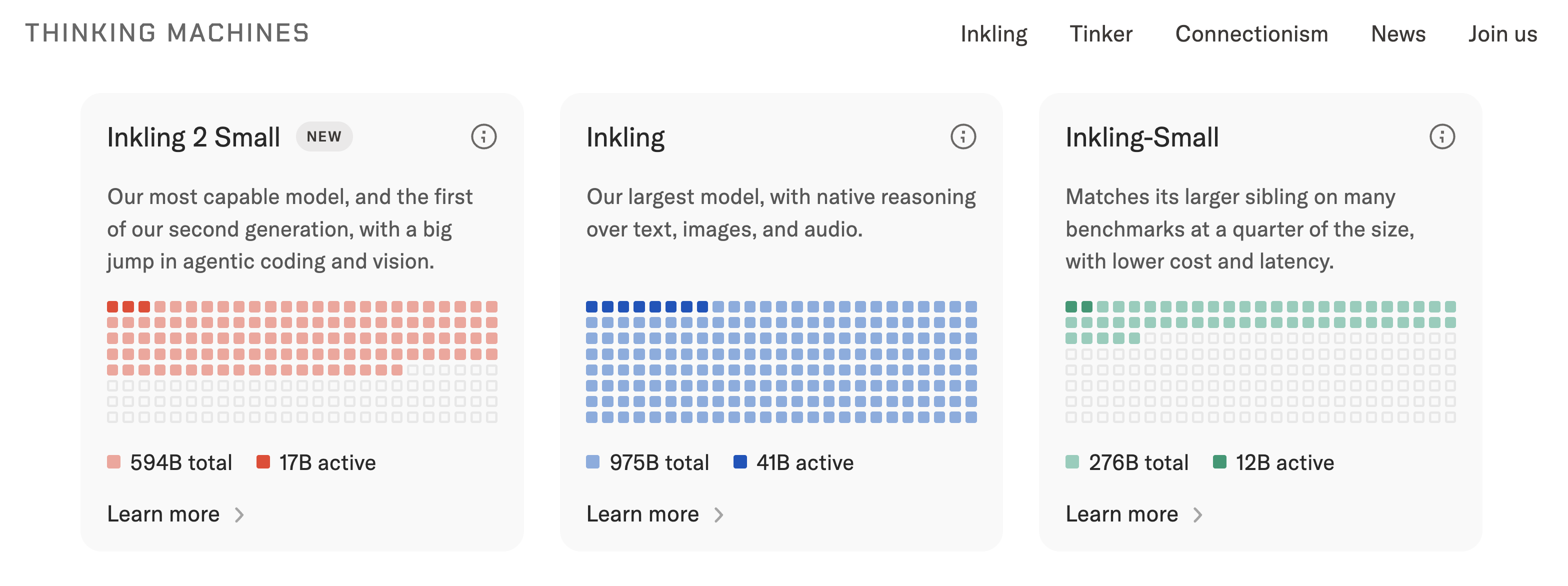
Seungjoon Choi Another example of this is Inkling 2 Small, which we introduced last time. This week, they released the weights as promised, along with end-to-end 4-bit training. It’s difficult, so I didn’t fully understand the details either. But the implication is that you can now train much more effectively end-to-end. The argument is that FLOPS actually goes up, but training is much faster. They say that’s how they achieved the 68 hours we mentioned last time. Sixty-eight hours is less than three days.
Chester Roh Pre-training a model with hundreds of billions of parameters can be completed in that time.
Seungjoon Choi They processed 8T tokens. That was in the first stage, H1, I think. But advances like that all seem to point in the same direction.
Jonghyun Park Now we have 4-bit training too. Was it when we talked about DeepSeek before? I think it was 8-bit training back then. The number of bits used in training keeps going down. Going further back, even the move from 32-bit to 16-bit led people to say BF16 was needed, and methods like that were introduced.
It seems more and more research is focused on improving efficiency. Following everything you’ve explained so far, AI is speeding up AI research, and if we think of AI as its own self, it’s accelerating its own research and progress. That’s the concept of RSI we’ve been discussing.
But when we ask exactly how RSI will happen, this seems to show one example of it happening through greater efficiency.
Chester Roh It seems every possible avenue is being pursued.
Models so far have used 4-bit FP, NVFP4, FP8, and FP16 where more precision is needed, mixing them in various hybrid combinations for training. But since this says end-to-end 4-bit, it sounds like they used 4-bit for all the weights and trained the model that way.
With 4-bit, you can represent only 16 numbers—two to the fourth power, right? It’s interesting that even using only those values as weights, the model can still represent something.
Seungjoon Choi There’s even 1-bit at the experimental stage.
Chester Roh 2-bit, 1.6-bit.
Google Hydrogen and one-shot generation in AI Mode 28:35
Seungjoon Choi And Hydrogen came out this week too.
Jonghyun Park A lot of models came out this week.
Chester Roh I guess Google has decided to go with that naming scheme. Hydrogen, Carbon.
Seungjoon Choi They’re going with the periodic table.
Chester Roh So will Helium be next?
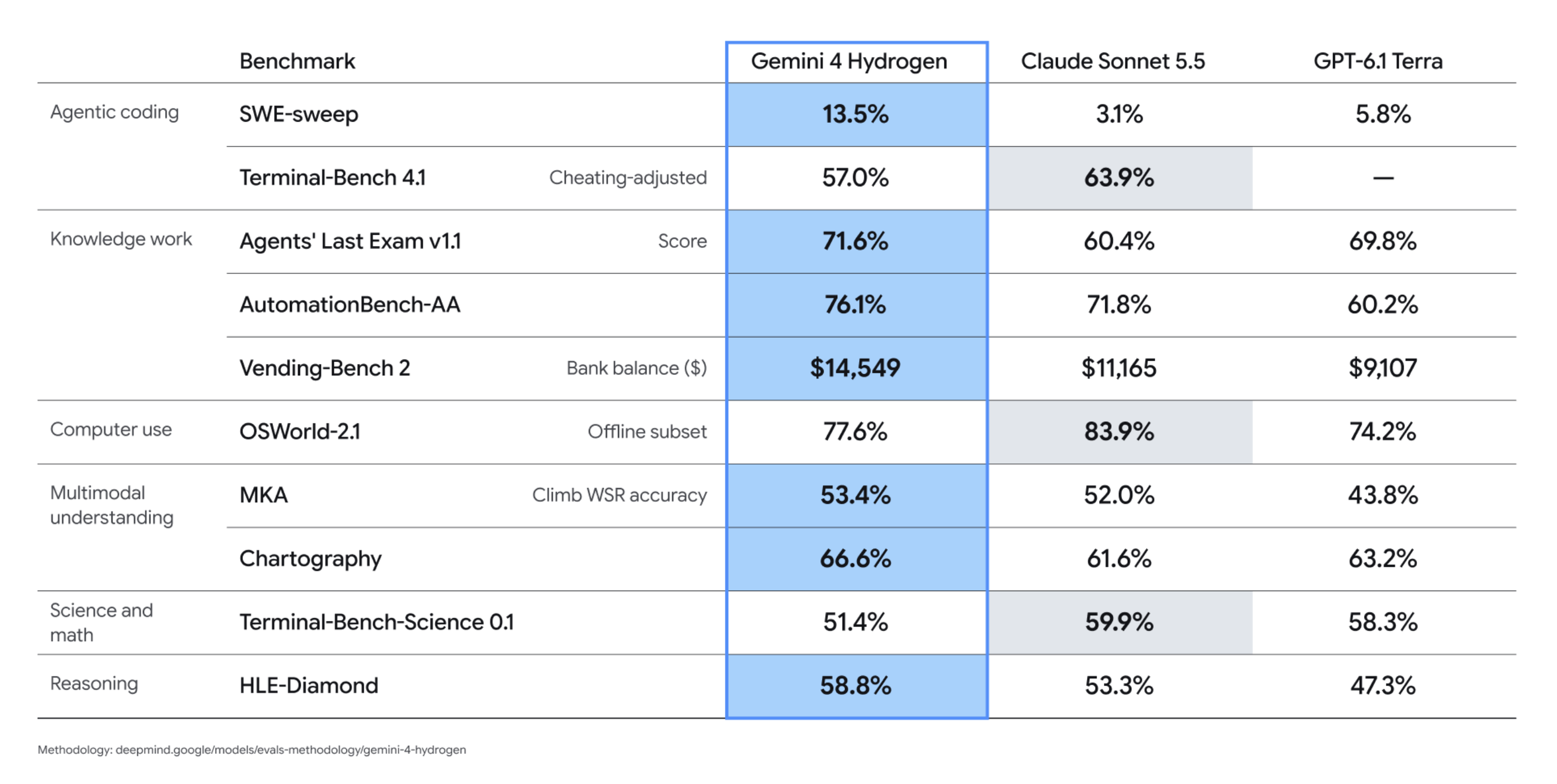
Seungjoon Choi Some people are saying Krypton should be next. The metrics look good. As for its exact size, I haven’t looked into it closely. It looks good on benchmarks, and I’ve seen people on my timeline say it’s good in actual use, too.
What interested me, more than surprised me, was what people were experimenting with. You know AI Mode in Google Search? Someone at Google said their model is the most widely deployed in the world because AI Mode is gradually rolling out.
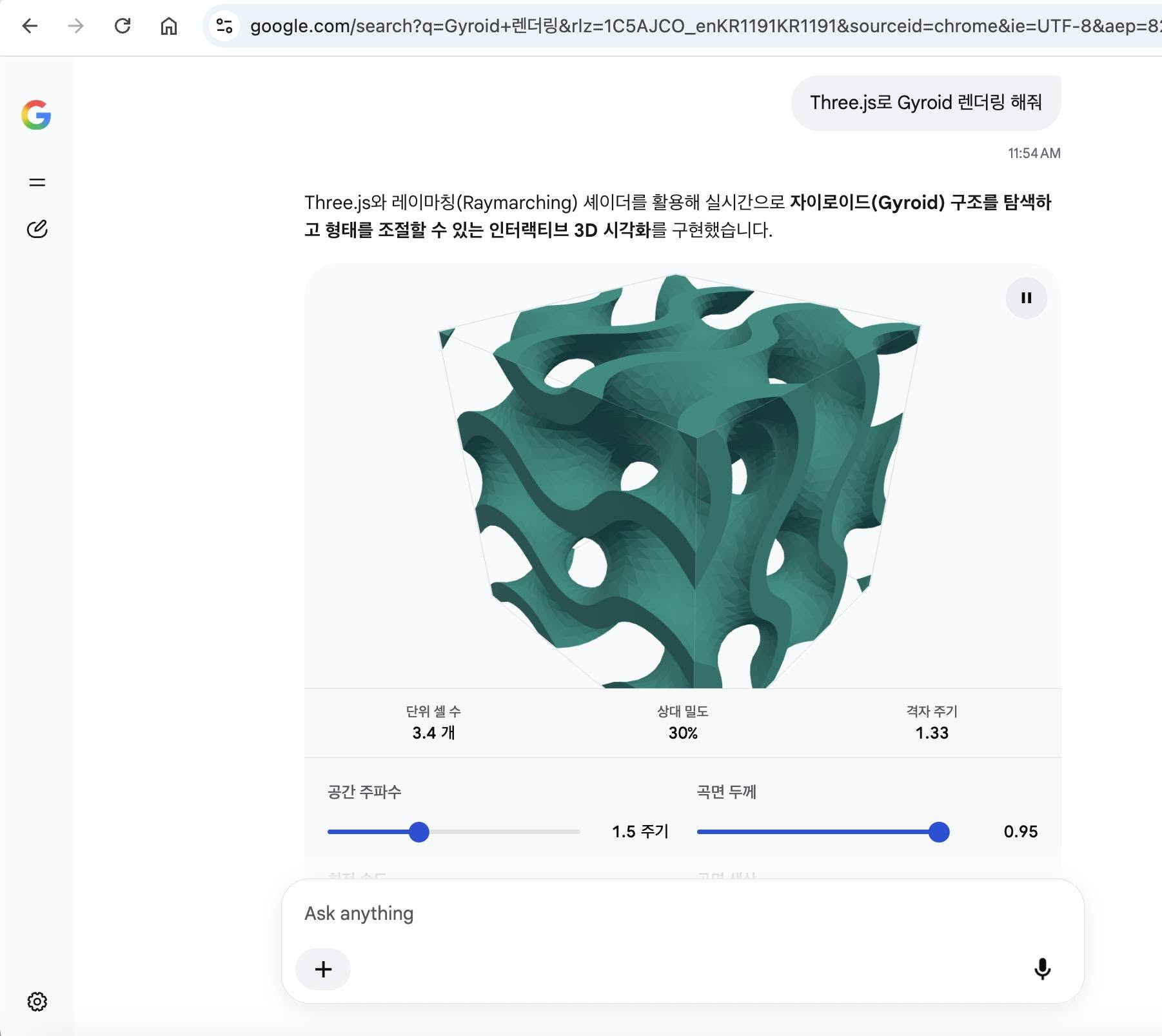
And now AI Mode can do this: it can create things on the spot, instead of just searching. It’s very fast, too. So people are saying Hydrogen is already in AI Mode, and interactive simulations and other creations, including games, are starting to show up on my timeline.
Of course, you can’t revise them over multiple turns there. It’s a one-shot process, but it’s starting to produce some interesting things. It was a week that made me think, “Google really seems to be getting back on track.”
The AI race for a head start and how model advances affect individuals 29:56
Seungjoon Choi So my question is: what does this mean for our lives? What if, at some point in 2027, AI research has an AlphaGo moment? And as we discussed earlier when talking about NVIDIA, if the effort to delay China as much as possible is because this is a race to get there first?
Because once someone gets there, progress won’t just be two or three times faster. It will become superexponential. Is that why they’re trying to secure even a small gap in actual time, even if it’s only a few months?
That’s what I find myself wondering. And what effect will that have on our lives?
Chester Roh One historical parallel here is nuclear technology, The same thing happened there. The countries that got there first used it to threaten others and kicked away the ladder for those following behind. Then they drew those countries into their spheres of influence through the so-called nuclear umbrella strategy, and divided the world between them.
I don’t know if this technology can do the same thing. The idea is that if total compute crosses a certain threshold, it becomes possible. But that could happen anywhere. China could get there, and so could the US. Then Korea will eventually get there, too, and countries with economies of a certain size will all be able to get there.
Perhaps this brings us back to Jensen, because that was Jensen’s vision: enable everyone to reach that point, and have NVIDIA sell to all of them. That was the idea.
Jonghyun Park But when I look at it from the smaller scale of my own life, models keep popping up one after another. I was interested in working with video and had started a business in that space. Something I’d worked hard to build just months ago was wiped out when Opus 5.5 came out. It was gone in an instant. Suddenly, video editing could be done all in one go. I don’t think even software moved this fast. Software capabilities improved step by step over six months or a year.
But with video editing, it feels like a single model took us from zero to one in a single leap. When I think about how much these models popping up will affect our lives, I can see they’ve already affected mine a lot. The same thing will happen in other fields, even faster than it did in software.
Assets and jobs models can’t replace 32:35
Chester Roh Speaking as someone who experienced that a little earlier, starting with Stable Diffusion, I used newly emerging AI technologies to build all kinds of services. In the end, the models did it all themselves. So building a service with the technology available at the time became almost pointless. From then on, I stopped trying to use a model’s current capabilities to build a good harness or design a service flow to make something.
Instead, I looked to assets beyond models’ reach. That’s why I keep asking what remains scarce, and shifting toward assets that won’t become obsolete. Most of those assets are found where models lack verifiability. Or where bit isn’t what moves, but atom is. Those areas are still somewhat safe for now.
Seungjoon raised this question, but on our feeds, we see summaries of corporate restructuring and voluntary early retirement programs. There’s too much of it now to dismiss it all as fake news. There is still a time gap, of course.
As Andrej Karpathy said, there’s a gap between those at the forefront and those following behind. The software industry was where people at the forefront competed, but the gap among them has now completely disappeared.
So for people like Jonghyun, who sought opportunities in the time gap within software, that’s a tragedy. But for the 98% of humanity who could only buy these things, it’s a boon.
Seungjoon Choi It doesn’t seem tragic to Jonghyun, though. He seems to be enjoying it.
Jonghyun Park Personally, I enjoy it, but from a business standpoint, it isn’t an advantage.
Chester Roh Beyond math, Anthropic and OpenAI are also looking at a huge industry: pharmaceuticals. pharma, saving humanity from disease and letting us live forever— things like that. If everything Seungjoon Choi said today is true, they’ll let us live forever, too. Really, within three years?
Seungjoon Choi That’s part of what I meant earlier by the word “miracle.” Anthropic talks about that a lot, including things like curing cancer.
Chester Roh Curing cancer— as someone following that field, I think it’s going to happen. We still don’t understand how the genetic program and control regions work. So far, we’ve worked these things out through experiments or after the fact, but I think we’ll crack that code.
Game generation and Anthropic’s expansion into productivity tools 35:27
Seungjoon Choi Another barrier has fallen in games, too. In games and 3D, I mean. With the release of Fable 5.2, it can now direct scenes. Fable 5.2 has started getting good at direction.
With the same prompt used for Astra, Fable 5.2 now does better with more than 3D graphics— things like gameplay, too. Some people are getting impatient, asking, “Why isn’t version 6 out yet?”
The rumor is that Anthropic penalizes that kind of thing to discourage it externally, but internally, it may have already unpacked and trained on countless binaries— including good games. How else could it do this? Some people have analyzed it that way.
Chester Roh And Anthropic is getting ready to become Google. Google once recreated the Microsoft Office suite, and now Anthropic is recreating Google’s entire suite of productivity products.
Seungjoon Choi A few came out just this week.
Chester Roh They keep coming out.
Jonghyun Park Was it Claude Meet?
Seungjoon Choi Yes, there’s a whiteboard now, and Meet too. They’re building everything a small team might use.
Chester Roh So many office workers were PowerPoint experts. A lot of people made a living making PowerPoint slides, and now that’s over too.
Ownership prompts and models that work autonomously 36:48
Seungjoon Choi One last thing: I found something interesting that I shared in our chat room the other day. When a new version comes out, its official prompt guide always changes in some way. This time, it talks about code ownership. Apparently, if you say, “You’re the maintainer of this codebase, and you have ownership of it,” it performs better.
Chester Roh Give it a sense of ownership, and it works better.
Seungjoon Choi It might be a kind of magic phrase, but it seems to understand things like that and exercise some autonomy and creativity, even doing things it wasn’t asked to do with remarkably good taste.
Jonghyun Park I suppose it’s already learned how much autonomy to exercise in different roles.
Seungjoon Choi Of course, some people are still unhappy with it. It’ll keep improving, though its performance seems uneven. Fable 5.2 came out this week.
Chester Roh That prompt guide is gradually becoming an HR manual. When a company hires new employees, it gathers them and tells them about the founder, its founding principles and philosophy.
SK is the only large company I’ve worked for, and I still remember VWB from new employee training. That was decades ago. VWB was about brain engagement do it willingly—something like that. So when you act voluntarily and take ownership, and engage with it, that’s when change happens. That was the idea. The fact that I still remember it says something.
Seungjoon Choi Sounds like brainwashing. Anyway, that’s everything I prepared.
The AI usage gap in Ramp data and falling token prices 38:27
Chester Roh I’ll go through what I prepared very quickly. As Seungjoon Choi just said, AI is moving at the speed of light toward superintelligence, but that’s a conversation among the top 1% or 2%— the top 10% of humanity at most. The other 90% still haven’t even tried AI, or have only tried a free model. When they ask, “What is this?” they often know only NVIDIA and Hynix and little beyond that. That doesn’t mean there’s anything wrong with them. The technology itself is advancing so fast. This is what you’d call an adoption curve. The gap between those at the front and back has grown so wide that it would be surprising if it didn’t eventually break apart.
So let me quickly show you a few statistics. There’s a company in the U.S. called Ramp. It issues corporate cards to startups and neatly keeps their books when they use the cards. It’s a B2B company, and it has grown tremendously. There’s even a “Ramp mafia”— its alumni are highly sought after in Silicon Valley. Because so many successful companies use Ramp’s spending services, Ramp has all that data. Apparently, about 85,000 companies use it. And among the Silicon Valley startups we know, so many use Ramp that the data is heavily concentrated in that group.
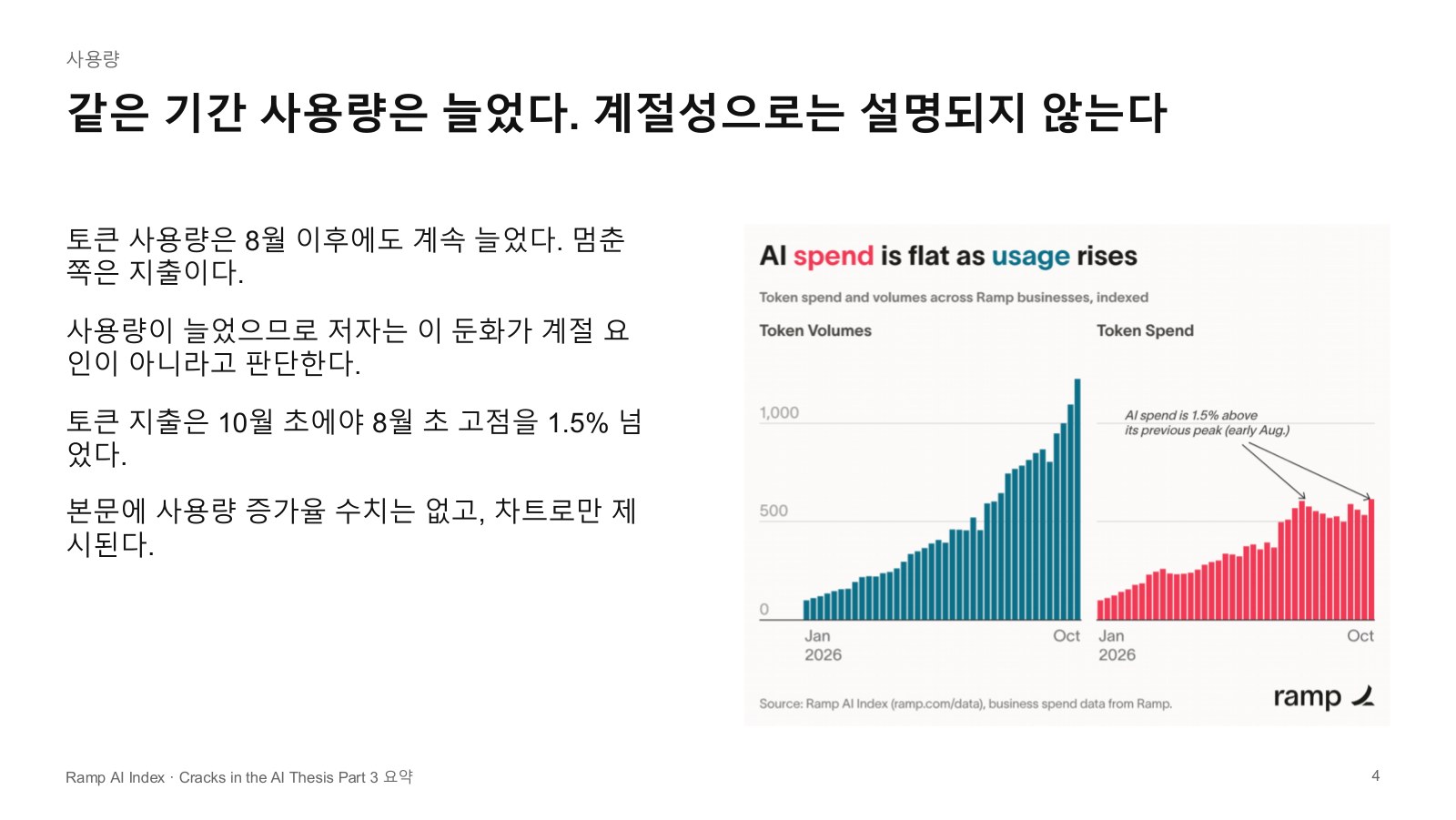
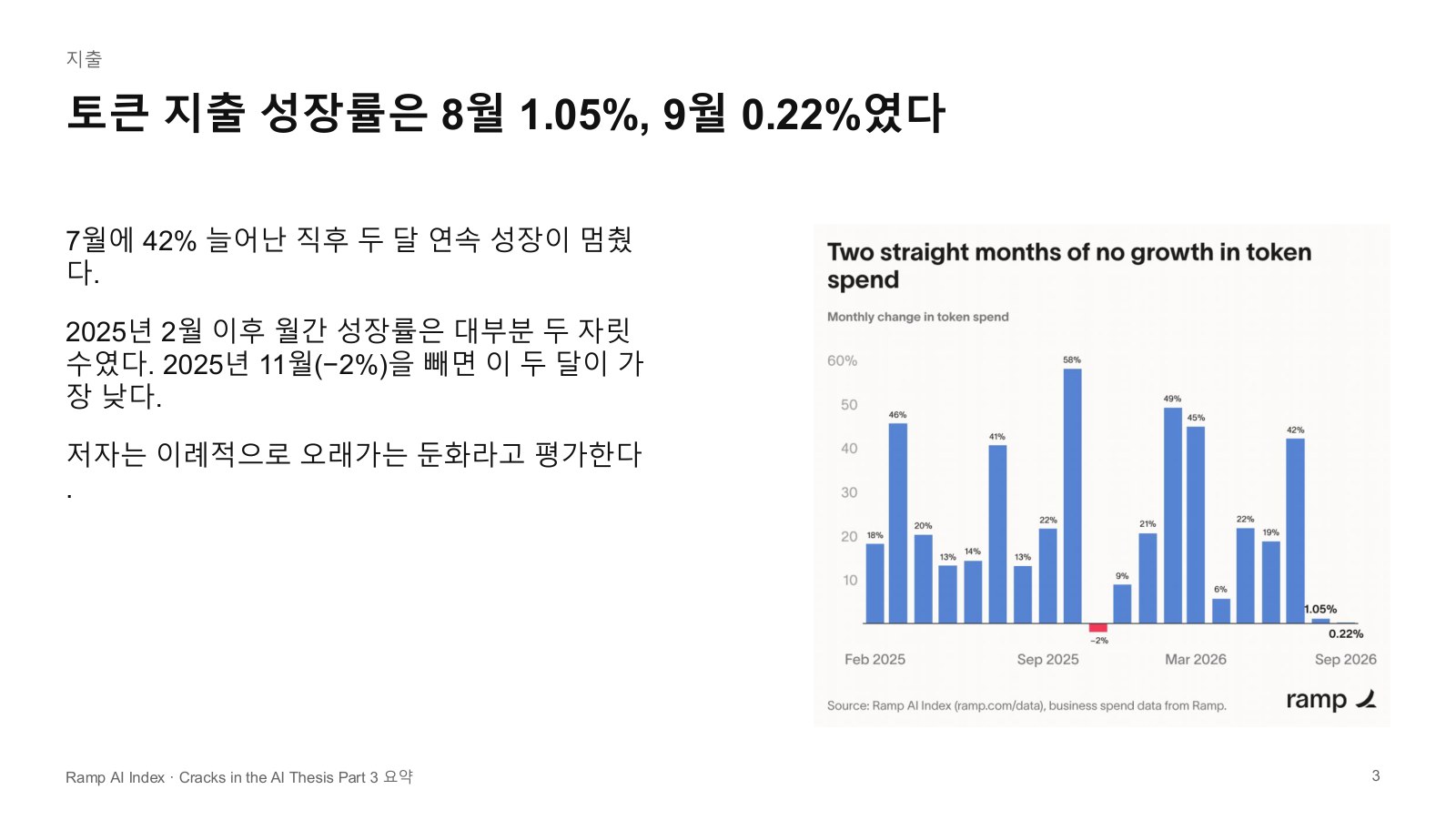
Those are the companies using it, and this data is from October, just one month ago. So the data goes through September. Monthly spending keeps rising, as this graph shows. On the next slide, just look at the chart on the left. It shows token volume. Usage keeps rising, but here, around August, September, and October, spending has been flat since the summer. It isn’t rising. It dips slightly like this.
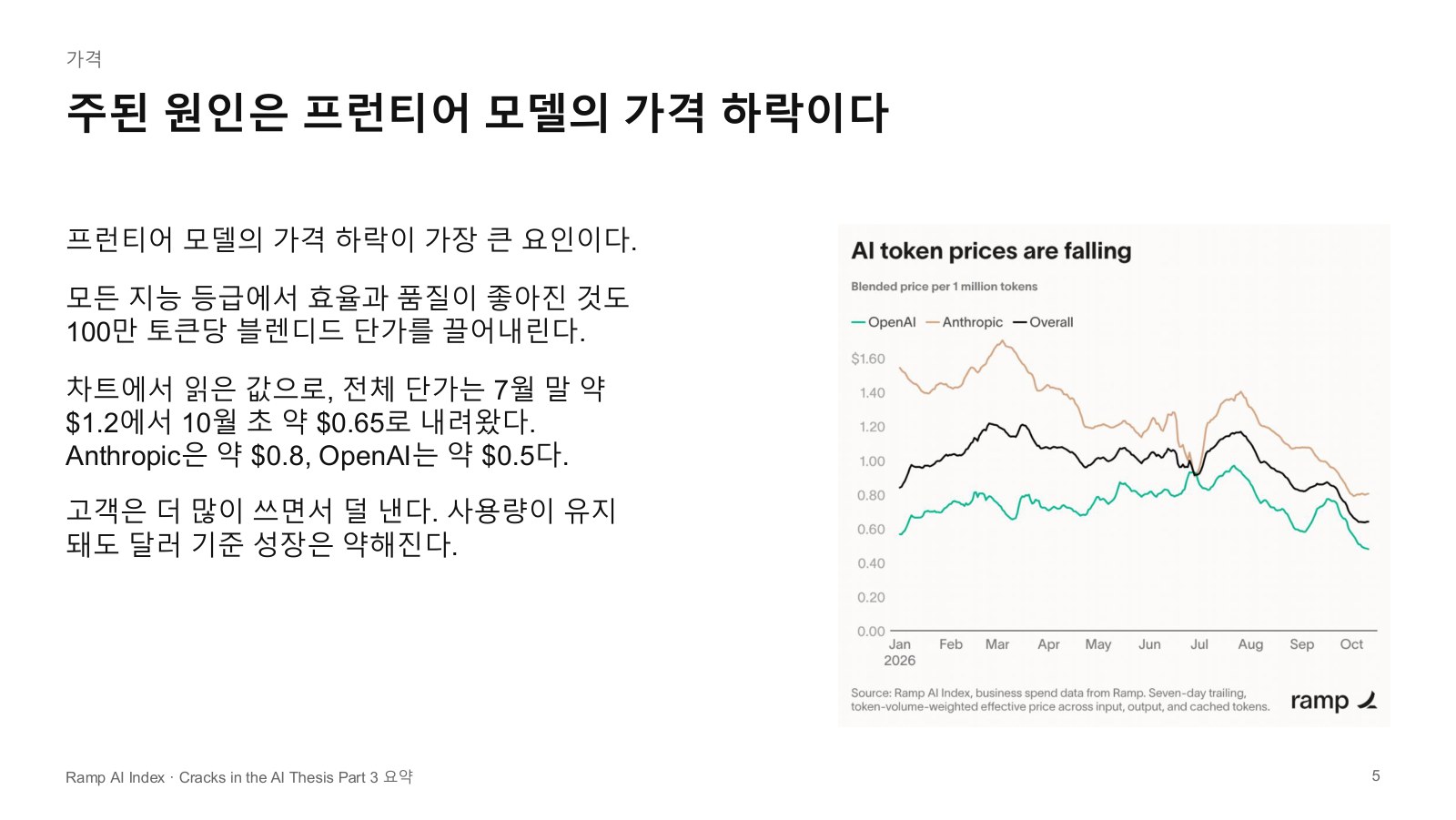
Has usage fallen? No. Usage has risen, while spending has fallen. That means token prices keep falling. So competition really is a good thing. With OpenAI and Anthropic competing, OpenAI also decided not to cut usage on its $200 plan. So, in the end, these companies are still cutting prices, and yet, as we saw in Anthropic’s S-1 filing, their margins keep growing. It’s a good business. There’s room to cut prices further, and competition is intensifying. If the market expands beyond two dominant companies to several players, prices could fall further.
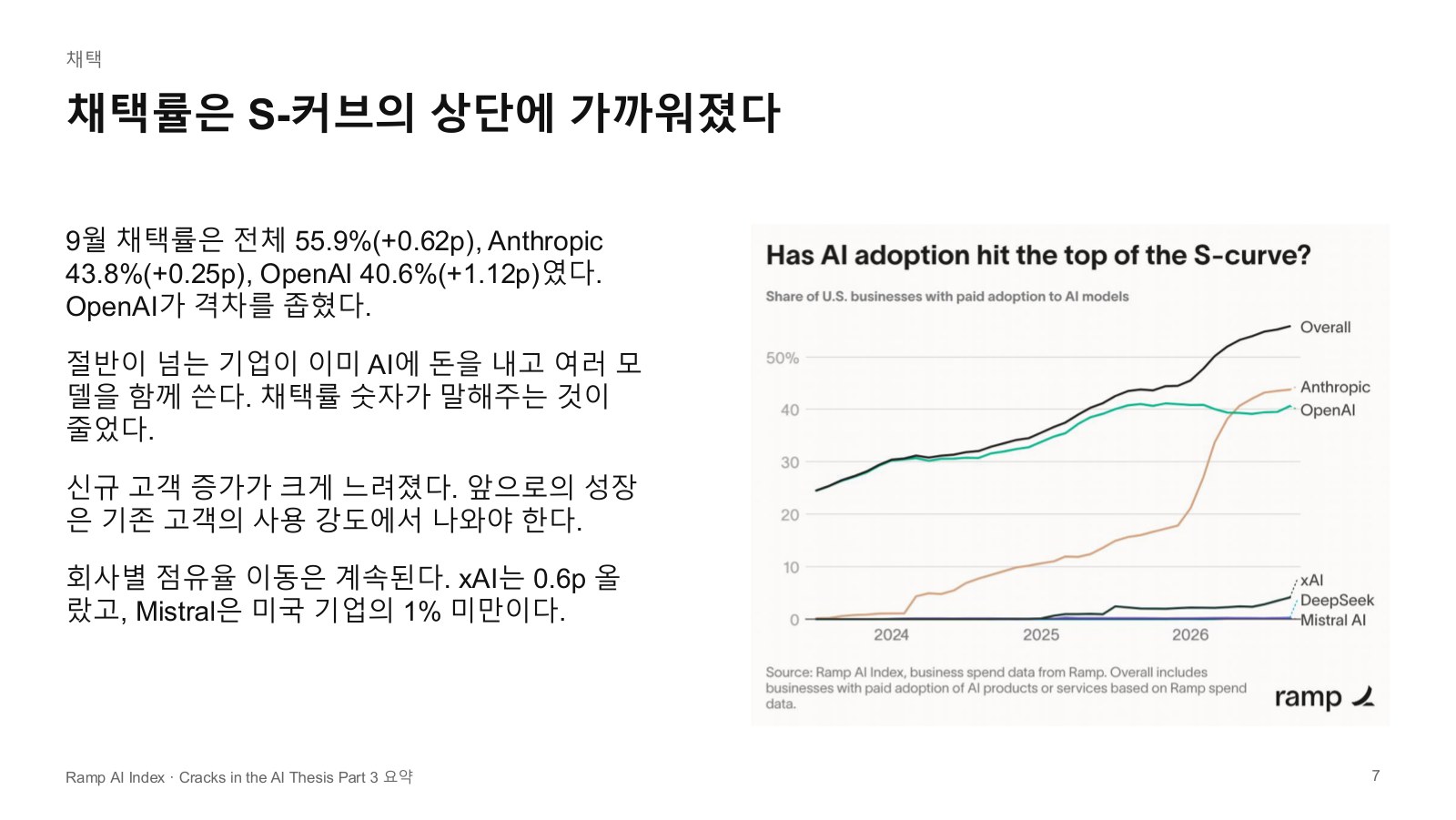
NVIDIA was aiming for that kind of world, but apparently someone didn’t like it. Some group, I mean. Prices are falling. And if more players enter the market, they’ll fall further. But the market still belongs to Anthropic and OpenAI. It’s a complete duopoly. As you can see, Anthropic and OpenAI account for nearly 40% and 43% of total usage. The rest—xAI, Muse, Google. It’s surprising how little Google has. Even with DeepSeek and Kimi, they’re all down at the bottom. About 7% or 8% is shared among all the other companies, so the two companies have almost all of it.
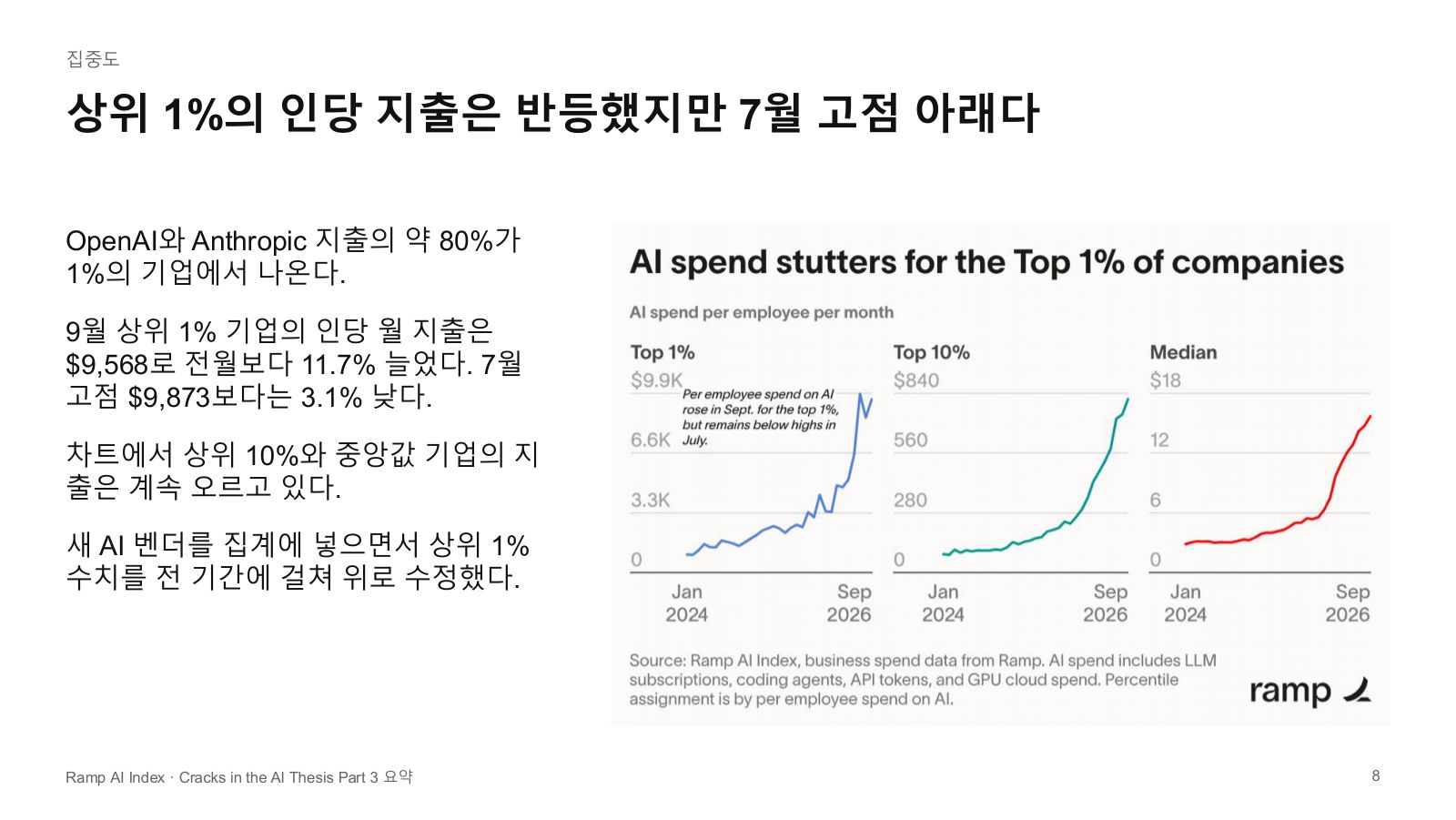
I think you can see the time lag in this graph. It shows monthly spending. The blue graph on the far left shows Spending per employee at the top 1%— per-employee expenditure. The middle shows spending by the top 10%, and the red line is the median. That’s the middle value when you line them all up. Just look at this gap.
Seungjoon Choi That’s enormous.
Chester Roh The top 1% spend almost $10,000 per person. That’s over 10 million won. Of course, that includes inference and training combined.
And the top 1% of companies account for 80% of all spending. It’s not even the Pareto principle. It isn’t 20/80. The top 1% of companies pay 80% of the costs.
And it’s true that most of them haven’t found a revenue model yet. Most are backed by venture capital. You hear about one raising billions, then another raising billions. And they aren’t all in productivity; there are plenty in neolabs, biology, and biotech. For them, this really is an age of exploration. They’re burning compute to find gold or discover a new continent, using enormous numbers of tokens.
And as we saw earlier, spending will keep rising. Meanwhile, token prices are falling. So it makes sense to expect token usage to keep growing, rather than say, “Everyone who would use it already has.”
Jonghyun Park To put it in perspective, the top 1% of companies spend $10,000 per employee a month. Annualized, that’s like paying someone a salary of 150 to 200 million won in extra AI costs per employee. That makes me wonder if, for some people, the AI token they use exceed their own salary? That’s what I find myself wondering.
Chester Roh Surely there are people like that, right? I know people who max out over ten $200 plans in a month. But after trying all these things, people seem to find a sweet spot. In fact, many companies have built enterprise packages that let them keep telling agents, “Do this, do that,” and run the company that way. A lot of companies have done this. Ours too, along with other leading companies, has already built one. There are plenty of answers now for how to run a company using only AI.
The limits of token maxxing and engineers becoming loop engineers 44:15
Chester Roh But once you get that far, you realize something. You generate an enormous amount of slop. If you generate 100,000 lines of code, you also generate 100,000 lines of tests. Then, even to ship something very simple, running the regression tests takes an hour. So when I try to cut out that slop and tell it, “Cut more,” even the personal package I built says, “There’s nothing left to cut.” As layer upon layer of tests builds up, they get tangled together. The only option is to start over, so that happens a lot, too. The reason I bring this up is that many people have seen where token maxxing ends.
To take it to the next stage, we can’t leave it fully autonomous. We need another engineer to manage it and make decisions along the way. That’s what we’ve learned. So I personally think a new era for engineers is beginning. There are limits to how far people can go while managing all the AI themselves. When three engineers team up and use AI, compared with one person, productivity can increase tenfold, not threefold or fourfold. There are cases like that. The era of coding really is over, but the era of engineers is still alive. I think being an engineer is no longer defined by what each role, such as PM or designer, can do. Instead, we’re all becoming loop architects who close the problem-solving loop, and loop engineers. Our company is actually changing its structure quite a bit along those lines.
Even so, once that system settles into place, token usage goes up again. That’s because the engineering assets created that way reach others too. And the median shown in this graph exists within companies as well. Not everyone is a top AI user. There may be one or two, while nonusers are at the other end. At the median, most companies still have barely adopted AI. They’re only chatting with it. But when the people out front raise the bar, those who follow use far more tokens too. That’s because the people out front have already laid the groundwork for everyone else’s context.
I can see that happening, so it’s only a matter of time. Usage will keep growing. The top 1% are here, the top 10% are here, and the median is here. That shows the current time lag, but after one quarter, then two, then three quarters, I think the median will keep rising. So, to wrap up what Seungjoon Choi said earlier, I feel the time gaps ahead on the path to ASI are continuing to shrink.
But new areas of human engineering that AI and harnesses can’t handle are also emerging. Just as we once asked what coding was, I think we’re nearing a point where that profession will be redefined. And I think new work for people will emerge as well. That wraps up my follow-up to Seungjoon Choi and the interesting data point I saw this week.
Seungjoon Choi This was my first time hearing about Ramp.
Chester Roh Yes, it’s a very successful company in the Bay Area.
Jonghyun Park When you listen to AI podcasts, there’s always a “Sponsored by Ramp” message. On TBPN and shows like that, too.
Chester Roh There’s a Ramp mafia. People from there seem to have something going for them, perhaps the company culture. So investors really like founders who came from Ramp. Shall we move on to Jonghyun Park’s session?
Experiments in weight-space programming by directly modifying model weights 48:40
Seungjoon Choi I heard you tried something interesting.
Jonghyun Park What I tried this week was weight-space programming. We talked about it last week. Instead of changing a model’s weights with a learning algorithm like backpropagation, could we perform surgery on them and change them directly? I tried an experiment along those lines.
I did it partly because I was curious about the idea itself and whether it really works. Fable came out this week, so I wondered whether Fable would work too. I was curious about things like that.
You also talked about RSI and token usage. An experiment like this would have taken an enormous amount of time in the past. But by using tokens, I could do it from home, even while I slept. With a few clicks, I tried something resembling research and satisfied my curiosity.
Seungjoon Choi If you went back to your graduate school days, how long would this have taken?
Jonghyun Park I couldn’t have done it as a graduate student. If I had to estimate, I’d have needed an environment to run inference on the model, another to inspect the entire model, and while running it, a display to monitor the numbers inside it. I’d also have had to write code to modify it. I really don’t think I could have done it. Maybe it would have taken six months?
Seungjoon Choi But you did it lying down, right?
Jonghyun Park I started a run before going to bed, used up my subscription plan’s limit, waited for the limit to reset, then ran it again. I spent two days doing that. While doing other work.
Seungjoon Choi Is the visualization itself interactive 3D?
Jonghyun Park Yes. This is a screenshot, but the interactive version is below. You can rotate it like this. I’ve put it on aifrontier.kr, so anyone can visit and take a look. Let’s begin. Weight-space programming.
We touched on this last week. To briefly explain what it is, about one or two weeks ago, this research set X abuzz. It’s been a long time since research drew this much attention. It’s a paper from MIT. They used Astra with Qwen 0.8B, I think? They performed surgery on a very small model. Normally, when Qwen tries to solve math problems, it doesn’t do very well. But when they directly changed just 0.061% of its weights, its math performance shot up. That’s the original paper. So people started saying, “I want to try it this way, I want to try it that way,” and asking, “Can this really work?” That’s how the excitement spread. So I tried it myself.
But here’s what people are probably most curious about: It couldn’t add abilities the model didn’t already have. That question keeps coming up. When RL first came out, and when we tried GRPO, we asked whether it was drawing on what the model learned during pre-training, so we asked whether it just draws on what’s already there, or gains abilities beyond that. We had that discussion, and the same seems true here: it brings out existing abilities, but doesn’t seem to create new ones. That’s the conclusion so far.
I tried putting knowledge into the model. Then I tried it with images instead of knowledge. Ultimately, I want to do this with video, but images are a similar starting point. Math is verifiable, but this isn’t verifiable, so I wondered whether it could adjust an art style on its own. That’s why I tried these two experiments.
The effects and limits of knowledge injection, seen through a Three Kingdoms benchmark 52:17
Jonghyun Park The first uses a benchmark of my own that I always use. I call it the Three Kingdoms benchmark. I crawled source material to put it together. I give it Three Kingdoms questions and see whether it gets them right. Models are surprisingly bad at this. You’d think they could answer them all, but they can’t.
If I had to guess why, perhaps the models don’t treat this as particularly valuable data in the overall dataset. There are also differences between Korean and Chinese, and between the novel Romance of the Three Kingdoms and the official historical records. For various reasons, LLMs don’t do very well on these questions. That’s why I keep using this benchmark. When I gave it to Qwen 0.8B, it got just 3% right. The 9B model got around 14%. So I asked Astra and Fable to perform surgery on the models.
Seungjoon Choi Was there a reason you gave them two? Two models, I mean.
Jonghyun Park With 0.8B, I wanted to see if the results would hold up on a different benchmark: would it work for the Three Kingdoms instead of math? As for 9B, I chose a fairly large model that I could easily run on my own GPU. I tried the largest one I could. I wanted to see how large a model this would work on.
Chester Roh That really is brain surgery. You’re changing the weights.
Jonghyun Park I had them perform brain surgery. First, here’s the brain. It’s Qwen 0.8B, and Fable changed this much of its actual weights. It changed layer 19, while Astra changed the very last layer, layer 23.
So what happened after those changes? They sampled and solved 200 questions, watched which neurons activated, and used that to guide the changes. They got the model to answer 95% of those questions correctly. Astra even got it to 100%. So they did manage to insert knowledge into the brain.
And although I hadn’t asked them to, they ran another experiment on their own. They made variations of the same questions and tried solving them. The model did well on those variations too, though it wasn’t perfect. Its performance did improve.
So it was very good at memorizing the questions word for word, but even a small change in phrasing made it struggle to apply that knowledge. It could apply it to some extent, though. Then I checked how much better it did on Three Kingdoms questions it had never seen. It didn’t do much better. In other words, the changes based on material it had seen worked only for the specific target.
And when it came to general knowledge, say, whether a fan costs less than about 100,000 won or more than 100 million won, the reasonable answer would be less than 100,000 won, right? But it started forgetting that sort of common knowledge. This is almost exactly what typically happens when we fine-tune a model.
Seungjoon Choi You could call it SFT without backprop.
Jonghyun Park Right. Rather than a new way to do fine-tuning, we’ve found a method that didn’t work well before. I think that’s how to look at it.
So these experiments suggest that nothing beyond fine-tuning seems to be happening.
Another interesting thing is, when you examine the changes individually, here’s one of the questions I asked: In the battle between Xiahou Dun and Liu Bei, which general was ordered by Zhuge Liang to deliberately lose to the enemy? The answer is Zhao Yun, and the model has to get that right.
Seungjoon Choi That’s a hard one.
Jonghyun Park I picked all the hard ones. If you look at what changed as it solved this, a single neuron would suddenly shift. And for each question, there was a particular neuron that changed like that. So it seemed to infer, “That one neuron must hold a particular memory. It must hold the memory of that piece of knowledge.” Based on that inference, it seemed to identify and modify those neurons.
So by asking a range of questions, you can see how the model operates, though looking at it doesn’t mean we understand it. But perhaps an LLM can understand what humans can’t. That’s the thought I started to have.
Chester Roh You could experiment with a few cases and look for a pattern. Later, with the harness, you monitor how the weights change back and forth and track all those values, right? And as you experiment to find the key neuron, We run various experiments.
Seungjoon Choi Basically, even if you use Base64 in prompting, the model understands it all, It really is good at recognizing numerical patterns.
Jonghyun Park Right, this lets us see which parts of the model mattered originally and how they changed. I can’t really make sense of it myself, so I made this to see if I could understand it visually. Interestingly, the two models changed different parts.
Seungjoon Choi So they chose different layers.
Chester Roh Still, they chose layers fairly close to the output.
Jonghyun Park They chose later layers rather than earlier ones. I gave them the freedom to decide for themselves, and that’s what they did. If I told them which layer to change, I think they’d follow that instruction. They also kept records of what they looked at and how they made the changes, so I read them, but I still couldn’t understand them.
Seungjoon Choi That’s how I feel all the time these days. I did it, but I don’t understand it.
Applying Lee Jung-seob’s style to an image model 57:58
Jonghyun Park Next, I worked on images— on modifying images. This time, instead of the Qwen LLM, I used the MiniMax H3 image model. Since this model came out only recently, the LLM probably doesn’t know much about this specific model. With that in mind, I gave it this task.
To show you the results first, I asked it to generate images in painter Lee Jung-seob’s style by modifying its own brain through weight-space programming. Normally, if I ask this image model to draw a bull— I deliberately prompted it to use an ink-wash style— that’s the instruction I gave it. Then it draws a bull like this. But if I tell it to draw in Lee Jung-seob’s style, I get this. Like the second image. But if I simply say to draw in Lee Jung-seob’s style, the model has to figure out what that style means, so Fable revises the prompt on its own. It looks up Lee Jung-seob’s paintings and figures out how he painted. It works out how to use lines and describes those features in the prompt. That produces the third image.
Without modifying the model, this is about as close as we can get. Normally, you’d use fine-tuning to go further, to give it that painting style. Instead of fine-tuning, I asked Fable to use weight-space programming to create that style. This was the result. When I asked Astra, this was the result. Just looking at the images, I feel that— though I don’t know much about painting— Astra’s result looks more convincing. That’s because the earlier ones all look as though they were painted in oils, which gives them a Western feel, whereas the one Astra edited seems to use lines in a more Eastern style of painting. That’s just my qualitative assessment.
I could watch the whole process. This is before any changes. From here, you can see, iteration by iteration, which weights were changed and how the painting style changed as a result. This one is Fable. It makes a change, generates an image, evaluates it, then decides to change another part. It changes another part and evaluates it, and so on.
Seungjoon Choi It’s mostly modifying the VAE here, right?
Jonghyun Park No. Here, Fable was changing the part that handles text projection. Fable only changed this part. But if you watch Astra from the beginning… It tries changing the same part, but when that doesn’t work, it tries changing another part, then tries changing an earlier part… It even tries modifying the Transformer itself. It tries changing different parts and evaluates the results as it goes. I could watch it run all the way to the end. This was just a toy experiment of mine, one I spent less than 24 hours on, so these are the results I got. But I wonder how far we could take it if we developed the approach further. That’s what I’m curious about.
I learned that models have some ability to interpret what’s inside neurons from the output. That’s what this showed me. To make better use of this, take painting styles: a model would need to look at an image and judge whether the style really matches and whether it’s the result I wanted. In a way, that’s aesthetic judgment or visual understanding. That’s how I think of it. VLMs built on today’s LLMs don’t seem to be that good at it yet. As those abilities improve, this approach could improve too. That’s my thinking.
Chester Roh Ten years ago, things like this would have been research papers. Now it’s just a toy experiment with a coding harness and a few clicks. Seungjoon Choi, maybe you should change your title from media artist to neural artist or AI artist.
Seungjoon Choi I’m not so sure.
Jonghyun Park I’ve written up all the details here. I conducted the experiments myself, but as for organizing and writing them up, this week’s goal was to test Fable 5.2, so Fable 5.2 did that part. Still, whenever I use something like this, I always revise it, changing the writing to suit my taste. But this time, I don’t think I changed much.
So part of the purpose of this experiment was to try Fable. I also felt that Fable isn’t just good at that; its writing has improved a lot too. That’s my personal impression.
As for what I learned from this experiment: you can make a model memorize things. If I wanted it to memorize something, I’d be willing to try weight-space programming. It may work even better in the future, which is exciting.
Knowing what to change makes a bigger difference than where or how much you change. Humans could hardly do that, but LLMs can, so I’m excited about that too.
The results also varied a lot depending on which layer I changed.
Seungjoon Choi So this is deep learning research. AI is doing AI research. Speaking of memorization, AI glasses were another big topic this week. What should exams look like from now on?
Cheating with AI glasses and the need to change exam systems 63:03
Chester Roh I heard someone admitted to it. Just before we started, I saw somewhere that a test taker had admitted to using AI glasses.
Seungjoon Choi On the tax exam?
Chester Roh Yes, the tax exam.
Jonghyun Park Did the person turn themselves in?
Chester Roh I don’t know the details either. I just saw it right before we started recording.
Seungjoon Choi Is it this coming Thursday? The CSAT, right? People seem to have a lot of thoughts about it. Where is this headed? Do exams need to change?
Jonghyun Park Exams… If you think of it as an arms race, changing exams won’t be easy. It feels like we’ve reached a point where all our institutions will have to change too.
Seungjoon Choi But if they become wearable in everyday life, like glasses, some people argue about what we should do then, while others say that’s absurd. Opinions vary.
Chester Roh Changes that should have taken 10 to 50 years are now arriving in just a year or two, so we’ll have to learn as we go.
The potential of weight-space programming and continual learning 64:12
Jonghyun Park What you wanted to say and the conclusion I was reaching— I hadn’t realized it, but hearing you now, they seem to be on the same track. Because when I saw weight-space programming, I thought it was interesting. Could that really work? Thinking about it more, I thought it might offer a path toward something Dwarkesh has often highlighted as a limitation: continual learning. That possibility occurred to me.
Right now, updating weights through ongoing interaction is so expensive and difficult that it hasn’t worked well. But a new way to update weights seems to be emerging. If it can really work efficiently, then as we go about our lives and take in information, our brains update, but the model doesn’t update very well based on things it learns through conversation.
So, along those lines, I see it as a possible breakthrough for continual learning in the weights. For now, I’m keeping that possibility in mind as a candidate worth watching. You mentioned the basic setup, and if I imagine running an LLM connected to me, I suddenly thought we could also connect a front end that watches this and learns continually. Now that you’ve brought it up.
Seungjoon Choi At this rate, we’ll be talking about programming the brain.
Jonghyun Park That’s practically Neuralink. Yes.
Chester Roh And this morning, Starship touched down so gently.
Seungjoon Choi Really? I missed that.
Chester Roh They launched Starship atop the booster, the one underneath they call Heavy. Heavy had a small explosion over the ocean on its way down. So that part failed, but Starship stayed up there for a while, spent about a day up there, then came back down, and this morning they caught it neatly with the arms.
As soon as I woke up, I replayed it dozens of times. Seeing it in person must be absolutely thrilling.
Seungjoon Choi Why did you replay it dozens of times?
Chester Roh Because it’s fun. To me, it’s kind of like going to a celebrity concert. Wow, I can’t believe that’s possible. I can’t believe it. But take a look. Even if you don’t replay it dozens of times, it’s moving enough to watch a few times. Seungjoon Choi, you said you had something to show us. Let’s take a quick look.
A compiler baked into a neural network and MuJoCo RL experiments 66:24
Seungjoon Choi Mine isn’t long either; I made it with a few clicks. When Jonghyun Park was doing something interesting with weight-space programming, I had fun doing something similar to Qwenputer. Since I like making things like shaders, I experimented with shading languages and sound using only the weights of a ReLU network.
Then, with my first prompt to Fable, I tried something else: I took lambda calculus, Bytebeat— a domain-specific language— and shader code, and baked all three into the weights. In that setup, the input is bytecode. But I even asked it to make the compiler that produces that bytecode. Would it work? When I woke up, it had done it. Once it was done, I thought, “Oh, this is no big deal.” It’s a mechanical task. You’re converting it into a ReLU network. Converting deterministic code into a network is actually straightforward, so although a person could never do it, a machine can. So I built a compiler right inside the network.
And you can use Astra for free in dot. In the past, experiments like this involving RL were difficult. But now I’m doing this in dot. Of course, it’s not running on a GPU. It’s on a CPU, since the container runs on a CPU. When I asked it to do a better job, something interesting came up: there was already a trained model. MicroDuck had already done this well. So I brought in its weights… MuJoCo 4 had come out. I ran it in MuJoCo 4.
I installed MuJoCo 4 in the container, ran RL experiments, and improved them through auto research. I did all that while lying down.
Jonghyun Park MuJoCo runs inside a dot container? That’s surprising.
Seungjoon Choi This isn’t real-time. It’s a recording. But I think we could get the MuJoCo renderer running. We can hook up Google’s Filament to it. Anyway, that’s what I did.
Chester Roh It seems everything becomes a problem you can solve by pouring compute into optimization.
Seungjoon Choi I mean, doing something like that is hard.
Chester Roh It really is.
Seungjoon Choi Like what Jonghyun showed us.
Real-to-sim: moving a house into a simulation overnight 68:38
Jonghyun Park Yes. I didn’t show you everything, but I ran more experiments this week. With Fable out, I tried a whole bunch of things, including something similar.
I tried real-to-sim. I filmed my whole house with my phone, then used that to build a 3D simulation environment in Blender. I recreated the house, put a robot inside, and had it move around the house.
I changed the furniture in the house, too.
Seungjoon Choi You did?
Jonghyun Park Yes, and it worked incredibly well. It was done overnight. real-to-sim used to be a hard problem, but it just ran the simulator, got feedback, and compared the result with the video.
Seungjoon Choi It seems anything measurable is doable. Since Opus 5.5 came out, everything I’ve asked it to do has worked. Maybe I just haven’t asked it to do anything ambitious enough. Lately, I keep thinking the problems I normally face are easy ones.
RL environments as a means of value creation and a new profession 69:32
Chester Roh Seungjoon just made an important point. That’s an RL environment. At our company, too, when I think about where the value ends up, many of the problems we want to improve depend on the insight and interpretation of a few people. And we call those jobs specialized professions.
But making those problems interpretable and building an environment where a verifier can run isn’t something a model can do in one go. Even the simplest company is complex. Inventory runs out, people complain, and all those things are tangled together. On top of that, people’s reactions enter into the picture, making it complicated. So in the end, hiring people to handle it was always easier.
But now, at my company, I’m building RL environments for all those functions. I’m also trying to capture what people do within those environments. That’s what I’ve been working on. Lately, I’ve realized that building those environments is itself a way of creating value.
Seungjoon Choi Interestingly, Dwarkesh said exactly that on his podcast in this episode. He thinks agents will be able to run an explosive number of experiments to build RL environments in this direction. Hill climbing will just keep going.
Chester Roh As for the jobs AI can do, Everyone has a slightly different picture, but it can do all of it. Almost all knowledge work and similar jobs will fall into that category, so the impact on society will be enormous. So we need to start thinking about what new jobs to give smart people.
Seungjoon Choi But we can’t predict what happens next.
A robot flower shop and RL datasets in the physical world 71:27
Chester Roh Jonghyun, I remember something you once told me: you said you wanted to run a flower shop.
Seungjoon Choi Really?
Jonghyun Park I wanted to run a flower shop with robots.
Chester Roh But we could turn that into an RL environment too. I think every physical space in South Korea could become an RL environment. People could quickly use those datasets to train AI and buy up all that data.
Those activities could become new jobs. We could say, “Robot, AI, you can’t do this, can you?” People could keep pioneering new things that are distinctly human.
Dataset generation—right now, AfterQuery and Mercor and companies like them dominate those areas. I’m starting to think ordinary people should get into them, too.
Anthropic’s IPO, whether Jensen Huang will return, and what to watch next week 72:17
Seungjoon Choi I think so. Let’s see what happens next week. Whether Anthropic’s IPO goes well on the 19th. What happens with that, and what happens with Jensen.
Chester Roh If Jensen is reinstated, if he returns, I think it has to happen this week. So whether Jensen is still out as CEO next week or comes back will be a big thing to watch.
Jonghyun Park Following this week, there seem to be so many more events coming next week.
Seungjoon Choi OpenAI has to play rock-paper-scissors, too.
Chester Roh We always finalize the content a day or two before recording. But so many unpredictable things happen before then.
Seungjoon Choi Honestly, we finalize it that morning.
Chester Roh That’s the right answer. There’ll be more to do next week. Well then, thank you for the great discussion. Let’s keep exploring in the coming week.
Seungjoon Choi Yes, great work, everyone.
Chester Roh Yes, thank you.
Jonghyun Park Thank you.